
👋 Welcome back everyone,
This week, a Senate hearing gone wrong gave us something the industry has been sitting on for years: hard data on how many Remote Operator it actually takes to run a robotaxi fleet. The answer is fewer than you think, and it changes the math for the entire sector.
Meanwhile, New York pulled the plug on robotaxi expansion, Uber put $100M into charging infrastructure, and Tesla’s Austin crash numbers got worse. Again.
Let’s dive in!
⏱️ ~3500 words, 16 minute read
Community Bonus:
London is becoming Europe’s real-world AV battleground.
Waymo is preparing its first European robotaxi launch. Wayve is running public-road trials with Uber. Baidu Apollo Go is bringing China-scale robotaxi experience to Europe via Uber and Lyft.
That is why the European AV Summit in London this March lands at exactly the right moment.
If you want to understand how robotaxis actually reach European streets, this is the room that matters.
Bonus for my community: you can get 20% off with the code: DANIELAV
Sign up here: European AV Summit
Looking forward to see you there!
Waymo Defends, New York Retreats, and Tesla's Crash Data Gets Worse
Waymo's Remote Assistance: What the Senate Hearing Got Wrong, and What the Numbers Actually Show
Earlier this month, Waymo’s chief safety officer Mauricio Peña testified before the Senate Commerce Committee. Most of the hearing was standard public education about autonomous vehicles. But it was Senator Ed Markey’s line of questioning about overseas workers that turned the proceeding into a viral moment, and not the kind Waymo wanted.
When Markey pressed Peña on whether remote assistance workers were based outside the United States, Peña confirmed that some agents were stationed in the Philippines. The senator was visibly displeased. “The Waymo phones a human friend for help,” Markey quipped, questioning how workers without U.S. driver’s licenses could be assisting vehicles on American roads.
What followed was a wave of media coverage and social media posts that largely mischaracterized the testimony. The implication, sometimes stated outright, was that Waymo’s robotaxis were being “remotely driven” by workers overseas. That is not what Peña said, and it is not how Waymo’s system works. But in the court of public opinion, nuance rarely wins.
Waymo’s response came this week in the form of a detailed blog post and a letter to Markey’s office, both authored by Ryan McNamara, Waymo’s head of global operations and a former U.S. Naval aviator. McNamara drew a sharp distinction between remote assistance and remote driving: Waymo’s RA agents do not continuously monitor vehicles. They do not steer, brake, or accelerate. Instead, they respond to specific, event-driven requests initiated by the autonomous driving system itself. The ADS reaches out when it encounters an ambiguous situation. The agent provides contextual advice. The system can accept or reject that advice. Interactions typically last seconds.
This is a fundamentally different architecture from companies that use teleoperators or remote drivers.
The letter also provided fresh operational detail that deserves careful analysis. As of February 17, 2026, Waymo has approximately 70 remote assistance agents on duty worldwide at any given time, including its Event Response Team. Half are based in the U.S., in Arizona and Michigan. The other half are in two cities in the Philippines. The ERT, which handles more complex situations like coordinating with emergency responders and managing post-collision protocols, is exclusively U.S.-based.
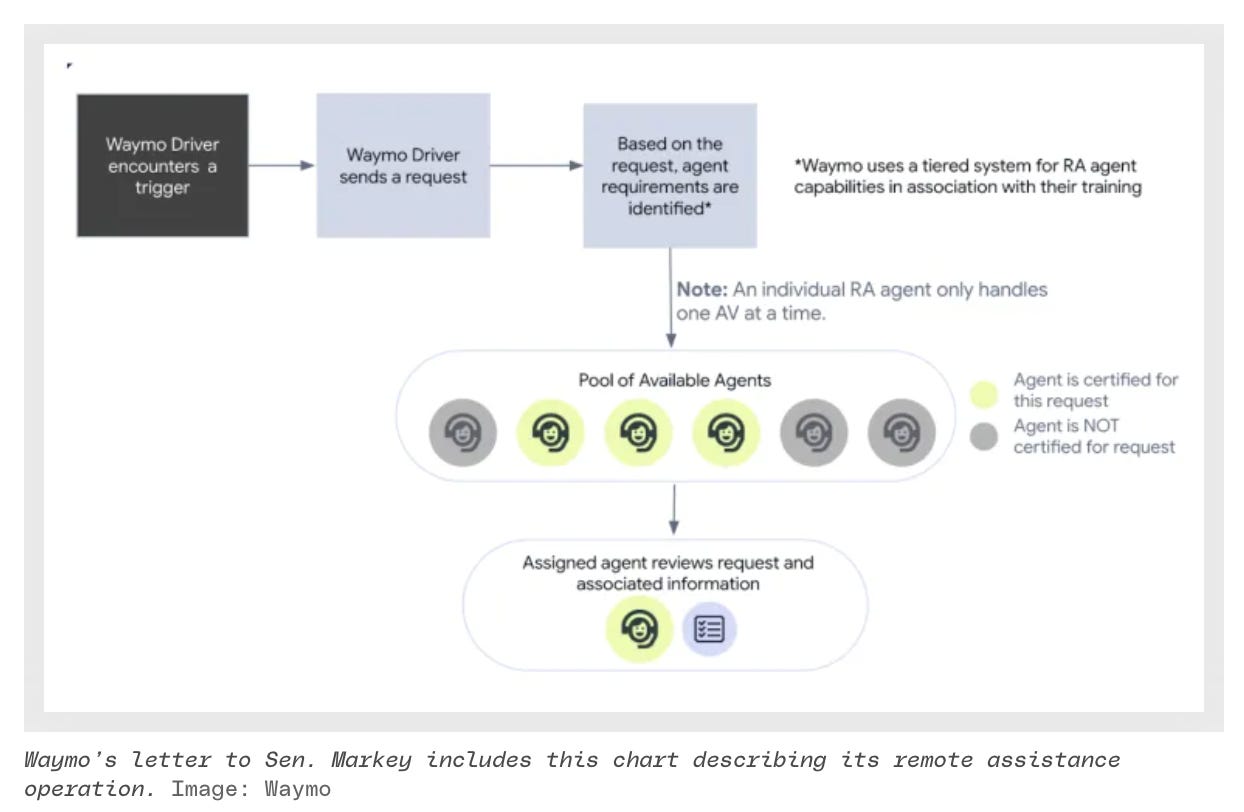
Now consider the fleet context. Waymo currently operates 3,000 vehicles. Those vehicles drive over four million miles per week and provide more than 400,000 rides. That means each on-duty RA agent is notionally responsible for roughly 43 vehicles at any given time. Waymo's ratio of approximately 1:43 represents the kind of labor leverage that makes the unit economics of autonomous ride-hailing structurally superior over time.
But it is more than an economic datapoint. The ratio is a powerful signal about the maturity of Waymo's autonomous driving stack. If the technology were fragile or frequently uncertain, you would need far more human backup per vehicle. The fact that 70 agents can cover 3,000 vehicles tells you the system is handling the vast majority of driving situations on its own, without requesting human input. Anyone still arguing that these are "just remote-controlled cars" now has hard data to contend with.
To appreciate how far ahead this puts Waymo, it is worth benchmarking against other significant players. In China, regulators long mandated a ratio of roughly 1:3, one remote safety operator for every three vehicles on the road, driven by traffic safety concerns and the politically sensitive issue of potential job losses among millions of traditional taxi drivers. That requirement has since loosened, and Chinese companies are pushing their ratios higher.
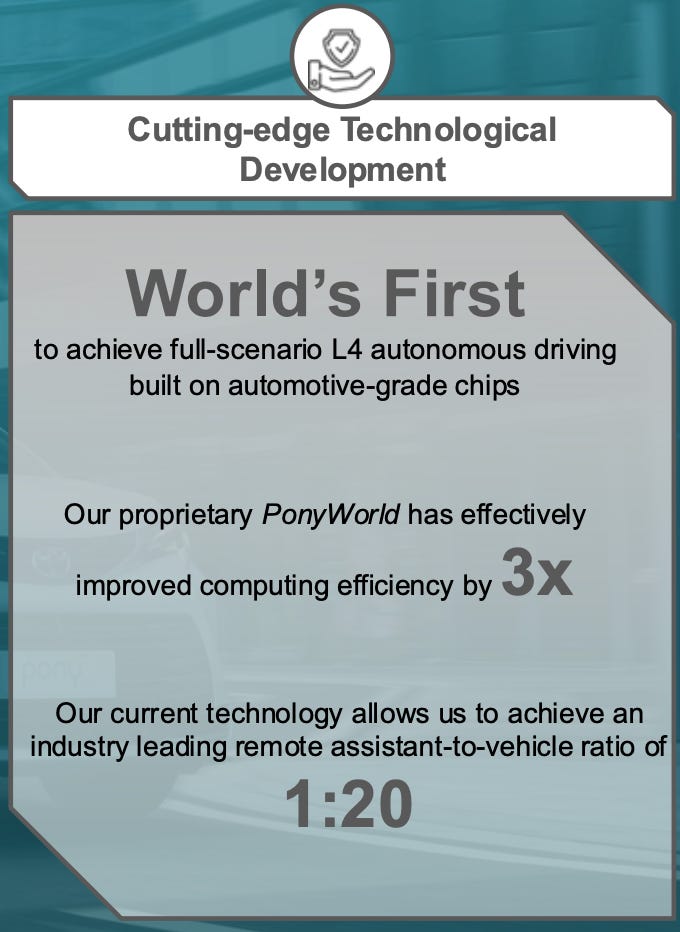
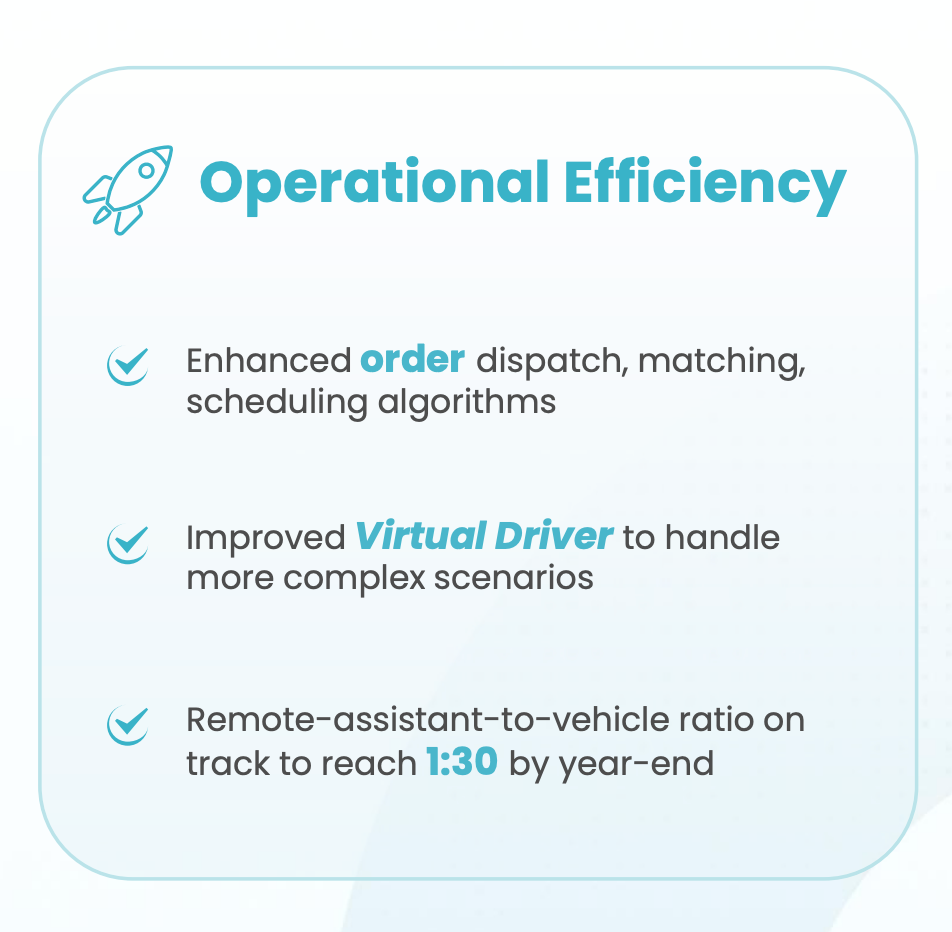
Pony.ai disclosed during its Q1 2025 earnings call that it had reached a 1:20 ratio for remote operators, with a stated goal of reaching 1:30 by end of 2025.
Source: Pony AI Q1/2025 Earnings Presentation
In Q3 2025, the company confirmed it was on track to hit that target, though Q4 data is not yet available.
Source: Pony AI Q3/2025 Earnings Presentation
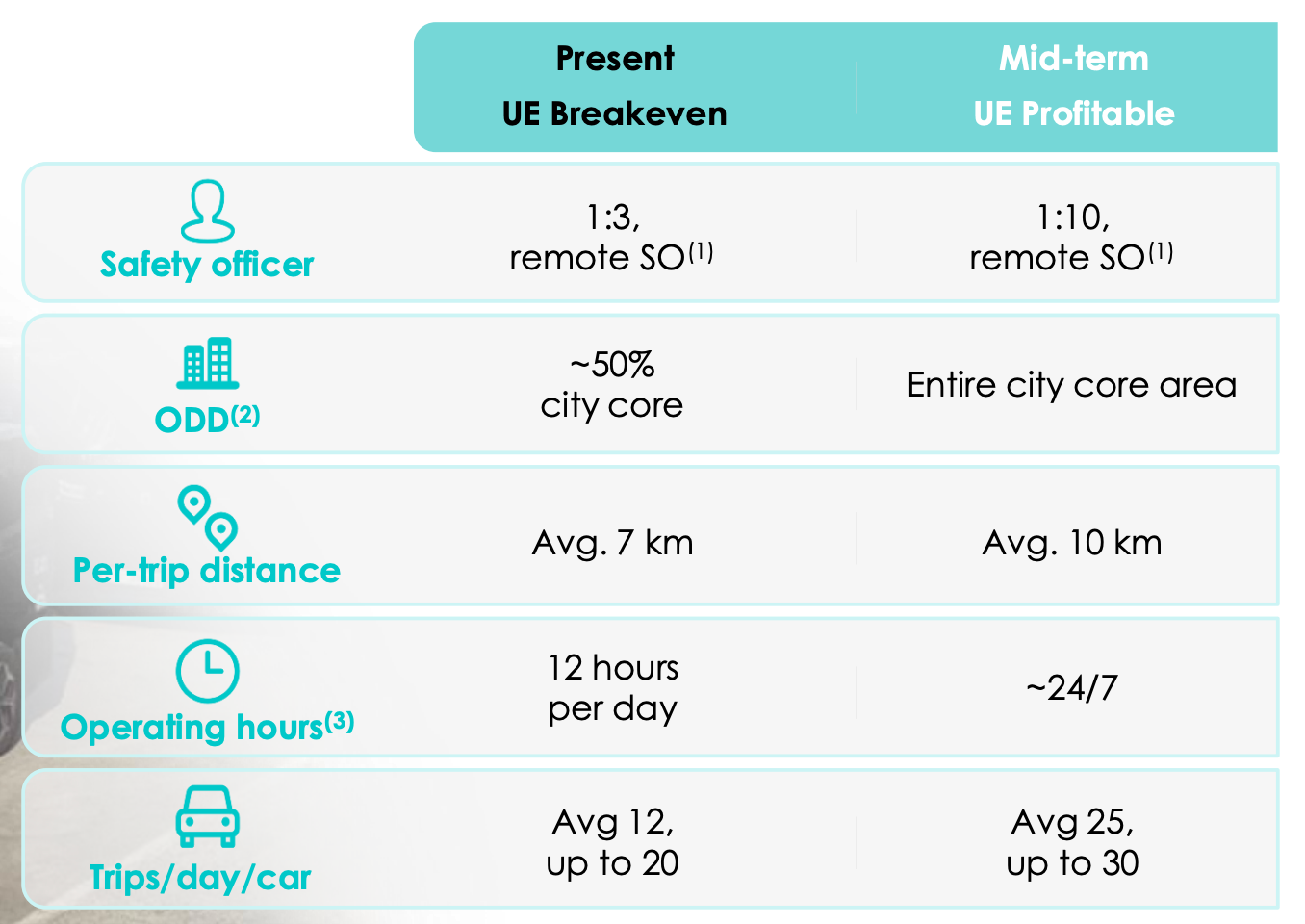
WeRide, by comparison, is earlier in this curve. Its Q3 2025 earnings report showed a 1:3 ratio for its Middle East operations, with a mid-term goal of reaching 1:10 in that region.
Source: WeRide Q3/2025 Earnings Presentation
For Baidu's Apollo Go, I have not been able to find publicly disclosed operator-to-vehicle ratios. However, a Goldman Sachs report on the Chinese robotaxi market noted that Chinese operators broadly expect to reach 50 to 100 vehicles per remote staff member in an ideal steady-state scenario, which would bring remote operations costs down substantially over time.
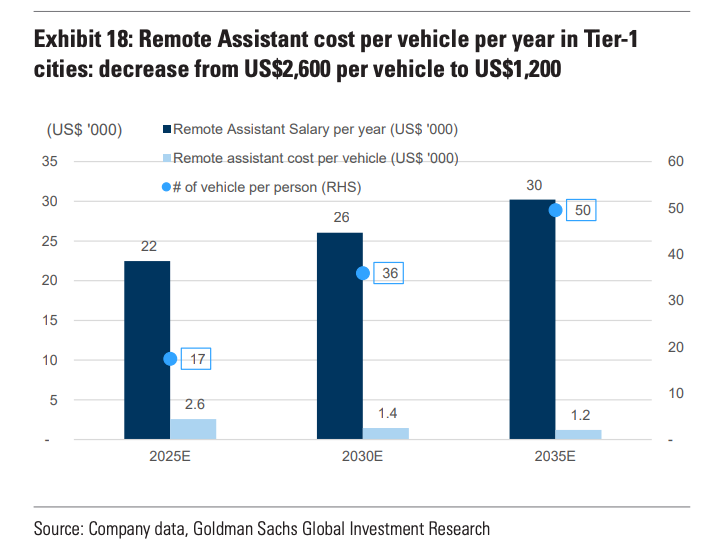
So Waymo, at 1:43 today, is already operating near a level that most Chinese competitors are targeting as a future aspiration. That gap matters for unit economics, and it matters for the investment thesis around autonomous ride-hailing more broadly.
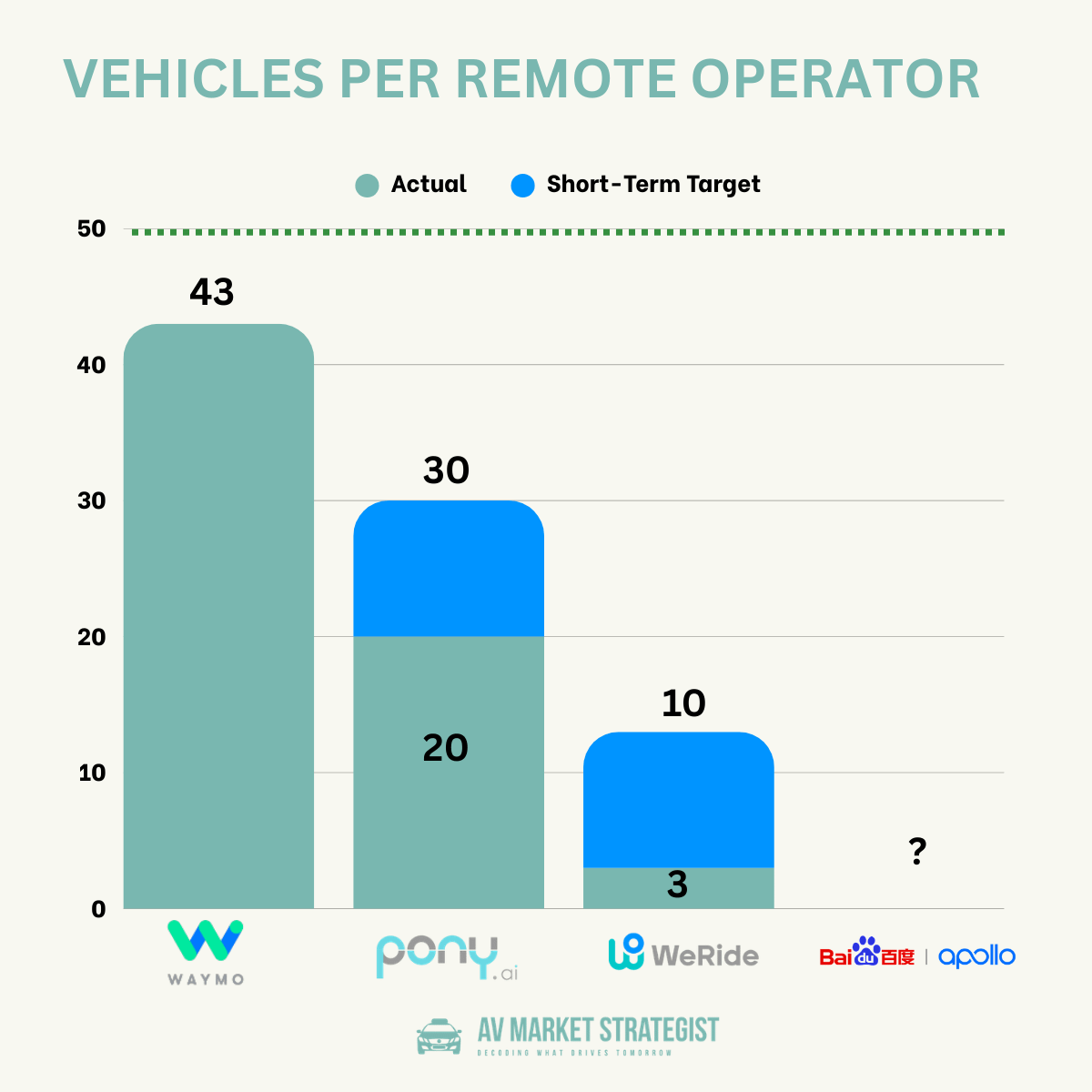
There is, however, one aspect of this disclosure that reflects poorly on Waymo's strategic judgment. I flagged this concern in an earlier edition of this newsletter: stationing part of your remote assistance workforce in the Philippines while actively seeking regulatory approvals across the U.S. creates unnecessary political risk. Now that we know the total number is only 70 agents at any given time, with roughly 35 in the Philippines, the decision looks even harder to justify. The cost savings from offshoring 35 positions are probably negligible at Waymo's scale. The reputational and regulatory cost, as the Senate hearing demonstrated, is real.
McNamara also disclosed latency figures. Median one-way latency between a vehicle and a U.S.-based operations center is approximately 150 milliseconds. For agents based abroad, it is roughly 250 milliseconds. Both figures are, as McNamara put it, "as fast as the blink of an eye." In practical terms, for an advisory system that provides contextual suggestions rather than real-time control inputs, these latencies are operationally insignificant.
There is one edge case worth noting. Waymo does have a tool for "a rare set of specific situations" in which a vehicle is stopped on a highway shoulder and needs to be repositioned. In this scenario, a U.S.-based ERT agent can prompt the vehicle to move forward at 2 mph for a short distance at fixed steering angles. McNamara stated this tool has only been used in training to date.
All agents, including those in the Philippines, hold valid driver's licenses, have passed drug screenings and criminal background checks, and undergo color blindness and spatial recognition assessments. McNamara declined to disclose the specific number of RA interactions per mile, calling the figure "not material," though he assured Markey that detailed records are maintained.
Carnegie Mellon autonomous vehicle expert Phil Koopman offered a measured counterpoint. “It is not about whether the remote human driver exists, because all robotaxis will need such a person for the foreseeable future,” he said. “It is whether the safety concept for that arrangement is acceptable.” He pointed to a 2024 incident where a Waymo robotaxi ran a red light due to an incorrect prompt from a remote assistant, and noted that independent oversight of actual operational practices remains limited.
New York Slams the Door for Waymo
While Waymo was managing the Senate fallout, it absorbed another blow from a different direction entirely.
New York Governor Kathy Hochul withdrew a proposal that would have allowed commercial robotaxi services outside New York City. The plan, which Hochul had included in her budget proposal just last month, would have created a pathway for companies like Waymo to apply for driverless pilot permits in the rest of the state. Hochul’s office cited insufficient legislative support. “Based on conversations with stakeholders, including in the legislature, it was clear that the support was not there to advance this proposal,” spokesperson Sean Butler confirmed.
Waymo called the decision “disappointing” and said it would work with the state legislature to advance the issue. Even though the proposal excluded New York City itself, operating in the broader state would have been a strategic stepping stone toward one of the world’s largest ride-hailing markets.
The New York Taxi Workers Alliance, representing more than 20,000 rideshare and taxi drivers, celebrated the decision. Executive Director Bhairavi Desai framed the issue in terms of labor market spillover: “If drivers lose jobs upstate, we would expect them to come to the city for work. There may be regulatory boundaries, but there is no practical boundary in this industry.”
This is the political reality that Waymo and every AV company must navigate. The technology may be ready. The economics may pencil out. But cities and states will move at their own pace, driven by labor politics, public sentiment, and legislative calculus. Waymo’s target of expanding across 20 cities in 2026 and reaching one million paid weekly rides by year-end is ambitious. New York’s retreat is a reminder that not every market will open on schedule.
Uber's $100 Million Robotaxi Infrastructure Investment
Uber plans to spend more than $100 million building high-capacity autonomous vehicle charging hubs in the U.S., starting in the San Francisco Bay Area, Los Angeles, and Dallas, the same markets where it plans to launch robotaxi services with technology partners.
The investment covers site development, charger installation, grid interconnection, and associated capital expenditure. Uber specified that the sites are designed for vehicles operating on the Uber network. When asked whether Waymo might use the new chargers, a spokesperson declined to comment, noting that Waymo runs its own service on its own app in the Bay Area and LA.
Uber also announced new charging partnerships with EVgo in New York, LA, San Francisco, and Boston; Hubber and Ionity in London; and Electra in Paris and Madrid. The company is guaranteeing utilization levels to these partners, meaning it will pay penalties if Uber drivers do not hit certain usage thresholds. This is designed to help operators justify rolling out more than 1,000 new chargers globally.
Strategically, this fits very well into Ubers playbook highlighted in the latest earnings call: While Uber remains committed to a asset-light structure in the long run, the company is currently deploying strategic capital to catalyze supply and expedite the integration of autonomous driving technology.
The $100 million figure is modest relative to Uber’s scale. The company has a market capitalization of roughly $150 billion. This is not a balance sheet transformation. It is a directional signal. Uber is embedding itself into the physical operating layer of autonomy, where fleet economics live. In a high-utilization AV fleet, energy throughput is revenue throughput. Every hour a vehicle spends charging is an hour not generating fares. Controlling that bottleneck improves reliability and asset turns.
Unlike the more speculative risk associated with picking winners among AV operators, where the gap between market leadership and total failure is narrow, investments in charging infrastructure offer a more resilient proposition.
The intrinsic value of these assets remains largely insulated from the success or failure of individual AV partners, as they capitalize on the broader, non-negotiable trend of global electrification. Consequently, demand for charging is fundamentally driven by the long-term transition to electric mobility rather than the performance of any single autonomy software stack.
That said, utilization guarantees create fixed obligations. If AV rollout is slower than expected, these commitments compress margins rather than strengthen the moat. And charging infrastructure on its own is largely commoditized, regulated, capital-intensive, and low-margin. The advantage only materializes if charging is embedded into a tightly integrated operational ecosystem.
RoboDock: Closing the Depot Gap
Speaking of that operational ecosystem, an interesting company surfaced in Harry Campbell’s newsletter this week that is worth putting on your radar. RoboDock is building what it calls "autonomous depots for autonomous fleets," deploying robotic systems that physically plug vehicles into chargers, verify successful charge initiation, and perform automated post-trip vehicle inspections.
The pain point is real. Despite all the focus on autonomy for driving, the depots that charge, inspect, and maintain AV fleets are still manually operated. RoboDock claims the typical depot spends approximately $900,000 per year on charging labor and overhead, with an additional $650,000 in vehicle downtime from missed issues and reactive maintenance. Their system is designed to retrofit into existing depots with no layout changes required.
For a company like Uber that is investing in charging infrastructure and managing third-party fleet operations for partners like Waymo in Austin and Atlanta, depot automation could be a natural adjacency. If the economics of robotic charging and inspection hold up at scale, this is exactly the kind of infrastructure play that complements Uber’s evolving position in the value chain.
Tesla's Austin Numbers: The Data Keeps Getting Worse
Finally, a necessary look at the other end of the transparency spectrum. Tesla has reported five new crashes involving its Austin robotaxi fleet, bringing the total to 14 incidents since the service launched in June 2025. The data comes from NHTSA’s Standing General Order incident report database.
The new crashes, from December 2025 and January 2026, include collisions with a fixed object at 17 mph, a bus while stationary, a heavy truck at 4 mph, and two backing incidents at 1-2 mph into a pole and a fixed object. Buried in the updated data is a revised report for a July 2025 crash that Tesla originally filed as “property damage only.” Five months later, Tesla quietly upgraded the injury severity to “Minor W/ Hospitalization.”
Electrek extrapolated from Tesla's Q4 2025 earnings data, which showed roughly 700,000 cumulative paid miles through November, estimating the fleet likely reached around 800,000 miles by mid-January. That yields one crash every 57,000 miles. Tesla's own Vehicle Safety Report claims the average American driver experiences a minor collision every 229,000 miles. By the company's own benchmark, its fleet is crashing nearly four times more frequently than a typical human driver. Against NHTSA's broader police-reported crash average of roughly one per 500,000 miles, the gap widens to approximately eight times the human rate.
Every single one of those miles was driven with a trained safety monitor in the vehicle who could intervene at any moment, which means additional crashes were likely prevented. And every single crash narrative is fully redacted as “confidential business information.” Tesla is the only ADS operator in the NHTSA database that systematically hides crash details. Waymo, Zoox, Aurora, and every other company provide full narrative descriptions.
For context, Waymo has logged over 127 million fully driverless miles with no safety driver, no monitor, and no chase car. Research shows Waymo reduces injury-causing crashes by 80% and serious-injury crashes by 91% compared to human drivers.
Looking Ahead
This week crystallized several dynamics that will define the AV industry through 2026.
First, regulatory access is not guaranteed. New York’s retreat shows that even supportive governors can be overruled by legislative and labor politics. Companies need to plan for uneven market access.
Second, Uber's $100M charging investment, the emergence of companies like RoboDock, and the growing weight of fleet operations all point to the same conclusion: winning in autonomy is not just about the driving stack. It is about infrastructure, energy, maintenance, and demand aggregation. The companies that assemble the deepest operational ecosystem, or embed themselves most tightly into one, will capture the most value. The race is no longer just about who drives best. It is about who operates best, and can prove it.
Third, Transparency is becoming a competitive weapon. Waymo's 1:43 remote operator ratio should become an industry benchmark. Every robotaxi company should now face the question: what is your ratio? If you will not disclose it, investors and regulators should ask why. On the other end, Tesla remains the only ADS operator that fully redacts its crash narratives from the NHTSA database. As public scrutiny intensifies and crash data accumulates, that position becomes harder to defend. The companies that share data openly will earn regulatory goodwill. The ones that hide behind confidentiality claims will face growing skepticism.
🔗 Bloomberg / Bloomberg (2) / WSJ / Waymo / Y Combinator / Forbes / The Verge / Electrek / Road to Autonomy / WeRide / Pony.ai / Pony.ai (2) / Goldman Sachs
Enjoying the AV Market Strategist?
If you find value in these deep-dives and enjoy the updates on autonomy each week — you can support my work.
Your contribution helps me access better data sources, industry reports, and research tools to keep every issue sharper and more insightful.
The newsletter will always remain free to read, whether you choose to support or not — but every bit of backing helps me make it even better.
💡 Quick Takes
FERNRIDE and Ukraine's Tencore Launch Joint Venture for Autonomous Military Ground Vehicles
Munich-based FERNRIDE, which was acquired by Quantum Systems in December 2025, has joined forces with Ukrainian company Tencore to manufacture TerMIT unmanned ground vehicles. The JV was one of three Ukrainian-German defense partnerships announced the same day in Munich. Tencore CEO Maksym Vasylenko described it as "Ukrainian combat experience and German engineering precision." This is the latest example of autonomous vehicle technology finding accelerated adoption in defense applications, where the urgency of demand and the tolerance for cost are both significantly higher than in civilian markets.
CharterUP Partners with Holon to Bring Autonomous Shuttles to U.S. Network
Group transport platform CharterUP has partnered with Benteler-owned Holon to integrate Level 4 autonomous shuttles into its nationwide network. Initial deployments will target controlled environments like campuses, airports, and transit agency routes. The Holon shuttle carries up to 15 passengers at speeds up to 37 mph and uses lidar, radar, and cameras. This follows Lyft's own announcement last year to bring Holon shuttles to its 44 million annual riders.
Scout AI Showcases Fury Autonomous Vehicle Orchestrator for Military Applications
Scout AI publicly demonstrated its Fury Autonomous Vehicle Orchestrator, a foundation model that translates a commander's natural-language mission intent into coordinated actions across mixed fleets of ground and aerial unmanned systems. The demo ran on real hardware in Central California with no scripted control. Fury acts as an "agentic interoperability layer," reading platform documentation and generating structured instructions native to each vehicle's API.
Neolix Crosses 100 Million Kilometers of Autonomous Delivery Driving
Neolix has surpassed 100 million kilometers of real-world autonomous driving across its 16,000-vehicle fleet deployed in 15 countries. The company's largest deployment is in Qingdao, China, where over 1,200 vehicles operate through a DiDi Freight partnership. Executive President Will Zhao framed the milestone as a shift from technical validation to commercial viability, noting that in-house manufacturing has reduced unit costs to roughly one-tenth of comparable products. Neolix is targeting full-year profitability in 2026 and plans to deploy 10,000 additional vehicles internationally. Europe is "unquestionably a strategic priority."
Lucid Motors Cuts 12% of Workforce While Doubling Down on Robotaxi Plans
Lucid is laying off roughly 12% of its staff to "improve operational effectiveness," though manufacturing, logistics, and quality teams are spared. The cuts come at an awkward moment: the company is ramping Gravity SUV production, preparing a ~$50,000 mid-size EV launch later this year, and collaborating with Uber and Nuro on a San Francisco robotaxi service. Interim CEO Marc Winterhoff stressed the strategy is unchanged, but Lucid has been without a permanent CEO for nearly a year following Peter Rawlinson's abrupt resignation, and has experienced significant executive turnover since. For the AV angle, Lucid remains a key Uber robotaxi hardware partner. If the layoffs slow the robotaxi collaboration or the mid-size platform timeline, that ripples directly into Uber's autonomous launch plans
Tesla Loses Bid to Overturn $243M Autopilot Verdict
A federal judge denied Tesla's motion to reverse a $243 million jury verdict from August 2025 that held the company partially responsible for a fatal 2019 Florida crash involving Autopilot. The jury assigned two-thirds of blame to the driver and one-third to Tesla, with punitive damages assessed only against the automaker. Judge Beth Bloom's ruling noted that Tesla's arguments were "virtually the same" as those already considered and rejected during trial.
📚 Worth Reading/Listening
Timothy B. Lee, Understanding AI: Waymo just revealed a crucial statistic for scaling its technology
🔗 Understanding AI
Harry Campbell: What the headlines about Waymo’s “offshore drivers” are getting wrong
🔗 The Driverless Digest
📊 Weekly Performance
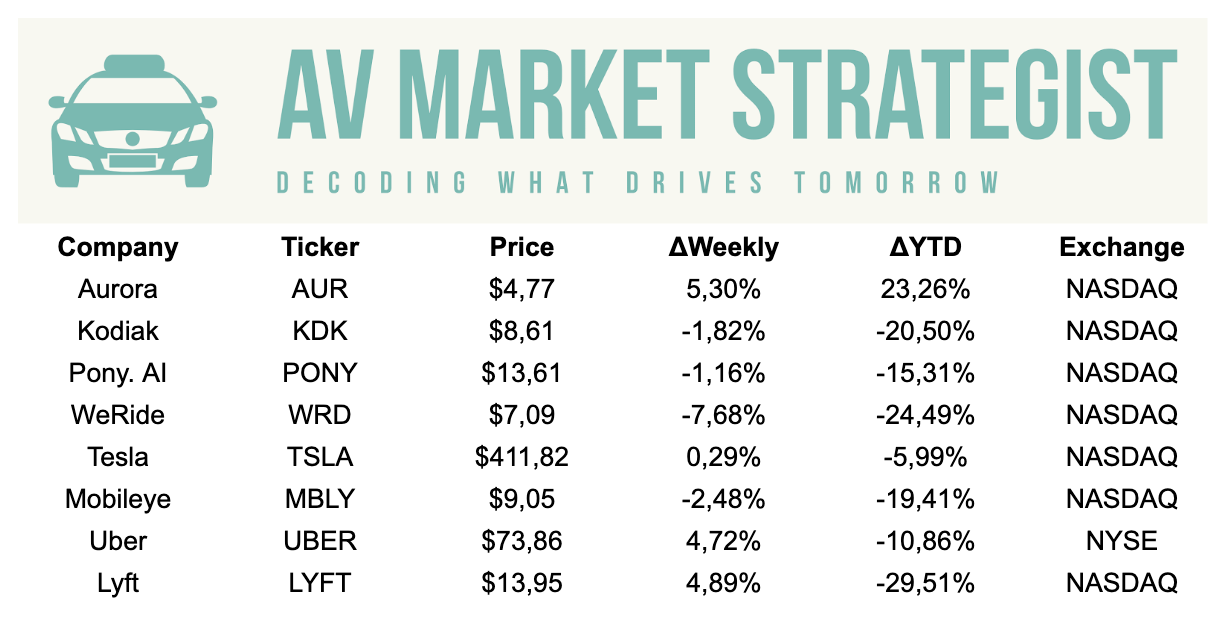
Note: Stock performance data as of 22nd February, 2026. Past performance does not indicate future returns.
Thanks for reading!
If you found value in this newsletter, please consider sharing it with a friend or colleague who might benefit from these insights.
And if you haven’t already, subscribe to stay updated on the latest developments in the autonomous driving industry.
Disclaimer: This newsletter is for informational purposes only and should not be considered investment advice. All opinions are my own.
Your 1:43 ratio assumes 100% capacity utilisation.
If I’m correct, Waymo represents the first or second top google’s investment