
👋 Welcome back everyone,
Waymo had another busy week, and all of it pointed towards expansion. This time the growth came from new riders and more vehicles on the road, and Waymo’s new safety data showed why it can afford both.
In Europe, Wayve signed its third carmaker, Switzerland is about to launch a paid robotaxi service with a safety driver still on board, and Tesla ran into trouble in Brussels.
⏱️ ~8900 words, 40 minute read
AD

The 7th edition of the European AV Summit will take place in London on 18 March 2027. I’ll be there. If you want to join me, you can use the discount code AVMARKET10 to save 10%.
Waymo turns its safety record into new riders
Waymo spent the week turning its safety record into new riders. For Zoox and Tesla, safety was what slowed them down.
Waymo now pays riders $2.85 to connect with public transit
Waymo launched a transit rewards programme in the San Francisco Bay Area. The mechanics are simple. You link a Visa card to your Waymo app, and when you use that same card for a Waymo ride and a public transit trip within two hours of each other, Waymo automatically puts a $2.85 credit on your account. The credit comes as Waymo Cash, which you can only spend on future Waymo rides.
The number is not random. $2.85 mirrors the region’s own transit transfer discount, which uses the new tap-to-pay Clipper system to give passengers a discount when they combine buses, light rail and subway. Waymo is borrowing the logic of the public network and applying it to the link between the public network and its own cars.
The programme is open to all riders in San Francisco first. Waymo says it wants to add other payment providers beyond Visa and take the programme to more cities over time.
The second half of the announcement gets less attention, and I think it is the more important half. Waymo is also getting dozens of dedicated robotaxi staging spaces at Caltrain stations, so that vehicles are already waiting when commuters get off the train, instead of driving in after the ride is booked.
This is Waymo’s third attempt at this. It ran a transit incentive in San Francisco in 2024 and in Los Angeles in 2025. What is new is Visa. The earlier pilots rewarded riders who were picked up or dropped off inside a geofence around a station. With card data, Waymo can now verify that a transit trip actually happened within two hours of the robotaxi ride, instead of assuming it did because the car stopped near a station.
Why would Waymo want this? Waymo’s own answer is that its riders are already transit users. The company says that in its most mature markets (San Francisco, Los Angeles and Phoenix), more than half of its riders also use public transit. Adam Lenz, Waymo’s head of sustainability and environment, framed it as “shared mobility is a team effort.”
There is a less poetic reason as well, and it is a cost reason. Back in June, I spoke with Billy Riggs, professor at the University of San Francisco, in EP14 of Autonomy Insiders. His team evaluated Waymo’s earlier Transit Credit Pilot, and his first explanation for why an operator wants this had nothing to do with goodwill:
“If you can consolidate a pickup and a drop-off in one location, and this is the great part about campuses and airports, you can consolidate pickup and drop-off into a quasi-trunk line, some type of more efficient route, you can reduce your stopping costs.”
A train station is exactly that kind of location. Predictable demand, arriving in waves, at a fixed point.
What the data from the last pilot shows
Riggs’ team interviewed riders of the earlier pilot as they got out of the vehicles. Three numbers from that study are worth keeping in mind this week:
69% of the credit recipients actually connected to transit
50% said they would otherwise have taken Uber or Lyft
6% would otherwise have driven their own car
So the pilot mostly moved people from one ride-hail app to another, and it rarely took a private car off the road. But Riggs points to the group behind the headline: the largest share of riders were people who wanted to reach transit but needed a ride to get there. “It wasn’t that transit lines didn’t exist for them. It was the fidelity of the service.”
He is also honest about the limits of the 69%. The incentive was paid whenever someone was dropped inside the station geofence, including when the station itself was their destination. Visa verification closes exactly that gap.
The most interesting part of our conversation was about who should pay. Riggs does not think Waymo should carry the incentive on its own. His argument is that a transit agency could fund it and still come out ahead:
“If you have distance-based fares, you may end up being revenue positive if you provide that dosage of an incentive. And reduce the starting costs for the customer, then what you’re doing is you may actually raise revenue on the tail end of the ride.”
His broader point is that agencies should “take agency.” If a transit operator lets a private company own the first leg of the trip, it gives up control of the customer. The alternative he mentioned is a white-labelled service like the one BVG in Berlin has been running with Via for years.
While Waymo is working on how riders reach its cars, in Texas it is working on how many cars there are.
Waymo’s Texas fleet grew 54% since the start of September
Two years ago, in September 2024, Waymo operated in three cities: Phoenix, Los Angeles and San Francisco. Today it offers robotaxi service in 15 US cities, most of them launched in the past year, and it averages 500,000 paid rides every week.
A TechCrunch analysis of Waymo’s fleet shows where the vehicles behind those rides actually are. About 80% of Waymo’s roughly 4,000 robotaxis sit in just two states, California and Texas. The other 800 or so are spread across Arizona, Florida and the newer markets.
California is no surprise. Waymo is headquartered there, did most of its early testing there, and serves a population that adopts new technology early. Texas is where the growth is right now.
According to the Texas Autonomous Vehicle Fleet Tracker, Waymo had 1,133 autonomous vehicles registered in Texas as of 26 September.
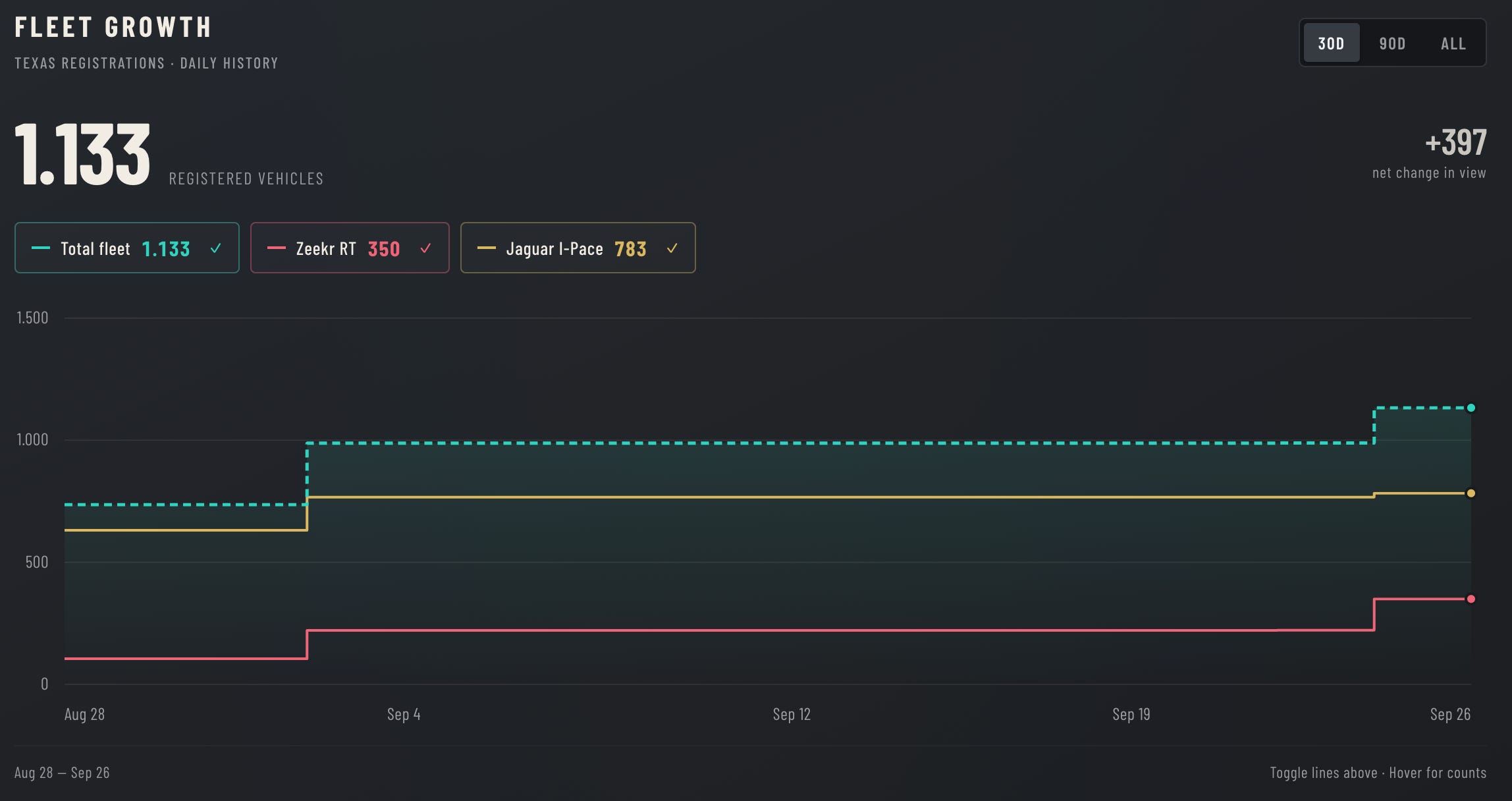
Source: Texas AV Tracker as of September 26th
For most of the summer, almost nothing moved:
End of June: 640
End of July: 677
End of August: 736
26 September: 1,133
That is 96 vehicles added in two months, and then 397 in less than four weeks. The Texas fleet is up about 54% since the start of September.
The driver of that jump is the Ojai. Today’s Texas fleet splits into 783 Jaguar I-Pace and 350 Ojai, so almost a third of Waymo’s vehicles in the state are now the new minivan.

Source: Texas AV Tracker as of September 26th
Waymo first launched commercially in Austin through Uber in March 2025 and has since added Dallas, Houston and San Antonio, so the Ojai is arriving into four live markets in one state.
It makes sense that Texas is where the Ojai shows up at scale. A robotaxi designed for high-mileage, high-utilisation service belongs in markets where Waymo is trying to add volume quickly, and Texas is where Waymo has four cities to fill.
Registered is not the same as in service
The same tracker shows how Waymo compares with everyone else registered in Texas:
Waymo: 1,133
Tesla Robotaxi: 546
Avride: 344
Zoox: 44
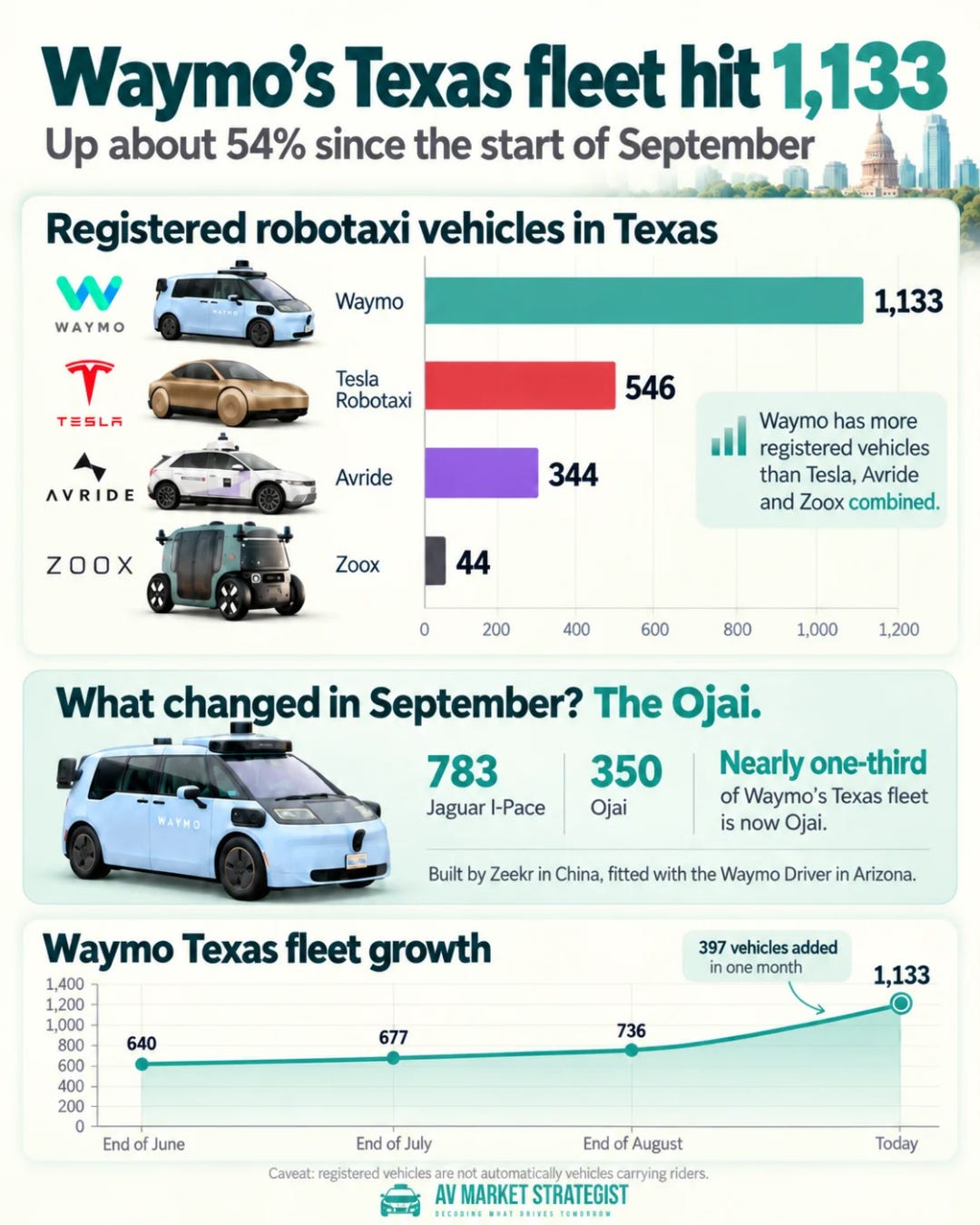
On paper, Waymo has more autonomous vehicles registered in Texas than Tesla, Avride and Zoox combined (934). But a registered vehicle is not automatically a vehicle carrying paying riders, and I think the numbers need to be read with that in mind.
For Waymo, I think it is fair to assume the vehicles it registers go into commercial service. Its Texas markets are open to the public, and the Ojai arrive in Texas already fitted with the Waymo Driver.
I hold that assumption less firmly for the others.
Zoox is the clearest case. Of its 44 vehicles registered in Texas, 39 are Toyota Highlander SUVs, the modified test vehicles Zoox uses to develop and validate its system, and the same vehicle at the centre of this week’s Atlanta story below. That leaves at most five of Zoox’s purpose-built robotaxis in the state.

Source: Texas AV Tracker
So for Tesla, Avride and Zoox, I would expect a good share of those registrations to be vehicles still accumulating test miles. Registrations are the best public proxy we have for fleet size. They measure very different things from one company to the next.
The cost of scaling fast
The complication for Waymo is cost. The Ojai is supposed to push Waymo’s per-vehicle cost down and eventually help it reach profitability, but vehicles built in China face steep import tariffs under current US trade policy, so every Ojai that lands carries a tariff bill. Waymo is clearly willing to absorb it. MoffettNathanson, which tracks Ojai imports through shipping records, says Waymo is on track to bring 5,100 of them into the US by the end of the year. That is more than Waymo’s entire national fleet today.
Where do they go? Texas, clearly. But Florida, where Waymo operates in three cities, and newer markets like Las Vegas are the obvious next candidates.
And Waymo keeps expanding. This time, though, the expansion is demographic rather than geographic.
Waymo opens teen accounts in Nashville
Waymo will let teenagers as young as 13 use its robotaxi service in Nashville. It is the second city with teen accounts, after Phoenix, and a Waymo spokesperson told TechCrunch it will be the “first of many” teen launches across markets that use the Waymo app in the coming months.
The rules are looser than you might expect. The teen account has to be linked to a parent or guardian, but once it is active, the teenager can hail a ride anywhere in Waymo’s Nashville service area and bring up to three guests aged 13 to 17. Waymo did not say how it verifies those ages.
Waymo says it will offer teen accounts where its operations are mature and local regulations allow it. Nashville has the support of local leaders. It is also a young market: Waymo launched a 50-square-mile service there in April 2026, and earlier this month its robotaxis became bookable in the Lyft app, as we covered in CW38. Note that teen accounts are a Waymo app feature. The same fleet runs on Lyft, but the new customer group comes in through Waymo’s own front door.
The growth logic is easy to see. Waymo’s paid trips grew tenfold, from 50,000 a week in May 2024 to more than 500,000 a week earlier this year, and most of that came from opening new cities (four in the past month alone: Denver, Las Vegas, San Diego and Tampa). Teen accounts add riders without adding a city. And this group depends on parents or public transit to get to school, work or practice.
When Waymo launched teen accounts in Phoenix, which we covered in CW29 last year, the accounts were for 14 to 17 year olds. Nashville starts at 13. And Waymo’s own criterion is “mature operations,” in a market that opened five months ago. Both details point the same way: Waymo is getting more confident about where it can offer this, faster.
The “so what,” for me, is trust. TechCrunch’s reporter put it well: it is not hard to imagine four 16-year-olds unleashed in a robotaxi. But a parent who would rather their child pile into a Waymo than into a car driven by another teenager is making the strongest possible judgment about the safety of that car. That is a judgment no other robotaxi company can currently ask parents to make.
Which raises the obvious question. Why would parents do this?
Safety. And on that front, Waymo delivered news this week as well.
New Waymo data: 841 injury crashes avoided in 271 million driverless miles
Waymo updated its Safety Impact hub with data through June 2026. The fleet has now driven 271.3 million rider-only miles, meaning miles with no human driver on board. That is about 50 million more than at the end-of-March update, added in a single quarter.
The miles are spread across five metros: Phoenix (92.1 million), the San Francisco Bay Area (82.4 million), Los Angeles (67.1 million), Austin (21.1 million) and Atlanta (8.6 million).
Compared with an average human driver covering the same distance on the same kinds of roads in those cities, Waymo reports:
82% fewer injury-causing crashes (841 fewer)
95% fewer crashes with serious injury or worse (55 fewer)
82% fewer crashes with an airbag deployment in any vehicle (358 fewer)

Source: Waymo Safety Hub
And the numbers are even better for the most exposed road users:
93% fewer pedestrian crashes with injuries (86 fewer)
86% fewer cyclist crashes with injuries (56 fewer)
82% fewer motorcycle crashes with injuries (36 fewer)
This is the first time Waymo has translated its percentages into an absolute number of crashes avoided. Rates are what matter statistically, but “841 fewer injury crashes” is the number that will travel.
The caveat, and Waymo’s answer to it
The obvious objection is scale. Electrek made it this week: human drivers cover about 3 trillion miles a year in the US, so 271 million miles still looks small.
Waymo’s FAQ addresses this directly, and I found the answer convincing. Whether two crash rates are statistically different depends mainly on two things: how many events you observe in the smaller population, and how big the difference in rates is. Once the human benchmark is above roughly 100 million miles, making it bigger barely changes the confidence intervals. So comparing Waymo against a large US city is, statistically, about as good as comparing it against the entire country. With tens to hundreds of millions of miles and reductions in the 70% to 90% range, the results are significant.
That said, the other caveats are real, and Waymo lists most of them itself:
Fatalities. There are not yet enough miles to report a fatality-only rate with statistical confidence. “Serious injury or worse” includes fatal crashes, but a standalone fatality comparison does not exist yet.
Road types. The benchmarks cover surface streets. Freeways are excluded.
Weather. None of the current cities has meaningful snowfall, so neither the Waymo data nor the human benchmark includes it.
Fault. The comparison counts all crashes regardless of who caused them, and Waymo does not share fault assessments.
Under-reporting. The any-injury human benchmark includes a 32% adjustment for crashes never reported to police, based on NHTSA research. The serious injury and airbag benchmarks have no such adjustment.
What sets this data apart is less the headline and more the method. The crashes come from NHTSA’s Standing General Order reports, which every AV operator has to file. Waymo publishes the report IDs so that outside researchers can replicate the analysis, and the hub carries endorsements from IIHS, the University of Michigan Transportation Research Institute, Virginia Tech Transportation Institute and Swiss Re. You can disagree with the benchmark choices. You cannot say they are hidden.
So, to answer the question from the previous section: yes, the data gives parents a reason. It is the licence for almost everything else Waymo did this week.
Staying on the safety theme, Zoox had a very different safety problem.
Zoox grounds its Atlanta test fleet after safety drivers report gas exposure symptoms
Zoox has grounded its autonomous test fleet in Atlanta after safety drivers were potentially exposed to carbon monoxide, carbon dioxide or hydrogen sulfide inside the vehicles in August, TechCrunch reported.
Here is what we know:
Who was affected. An OSHA letter to Zoox, seen by TechCrunch, said as many as 40 workers may have been exposed. Zoox says the number is lower. In its own letter to OSHA, Zoox identified 28 employees who rode in six test vehicles with an “unexplained odour.” Ten underwent medical evaluation, and Zoox says it received one medical report identifying CO₂ exposure.
What happened. Workers reported symptoms and strange smells through much of August. On 14 August, four contractors fell ill in one vehicle; one was vomiting. According to one of them, Jay Davis, the group was then put into a second test car and sent back out, where they got sick again. Three went to the emergency room. On 22 August, someone at the depot called 911 for a sick worker. Davis filed the OSHA complaint.
What Zoox did. It quarantined the test vehicles and has run the Atlanta facility at limited capacity since 22 August. It tested exhaust systems, ran smoke tests for cabin leaks, removed and replaced the 12-volt batteries, and says the only gas it detected was CO₂ (no carbon monoxide, no hydrogen sulfide, no battery damage). It will add gas monitors to the vehicles. OSHA has closed its inquiry.
Two details matter for reading this correctly.
First, Zoox’s purpose-built robotaxis are not affected. They are fully electric. The affected vehicles are the modified Toyota Highlander SUVs Zoox uses as its test fleet, which have combustion engines. That makes Zoox an outlier among major robotaxi developers: Waymo, Tesla, Avride and Motional all test with electric vehicles. Zoox keeps its test SUVs running for much of the day to maintain sensor calibration and cut the autonomy computer’s boot time, and it modifies the vehicles with sensors, a computer and an interior air “snorkel.” Zoox says it does not modify the ventilation system.
Second, this is a workplace safety story about the people who make autonomous driving possible. The safety drivers in Atlanta are employed through a third-party contractor, HireArt. The workers’ accounts of being sent back out after reporting symptoms, and of being ordered to take a drug test in the following days, are theirs, and Zoox has disputed parts of the picture. But as the industry scales, the human layer underneath it (safety drivers, test operators, depot staff) scales too, and TechCrunch has previously reported injuries to Zoox contractors from sudden braking and swerving. Waymo has reported similar test driver injuries to OSHA. The question of how that layer is treated will only get bigger.
Zoox had a crash on the Las Vegas Strip
That was not the only Zoox safety headline this week. On Friday morning, a Zoox robotaxi and a silver Nissan Murano collided on southbound Las Vegas Boulevard at Four Seasons Drive, near the south end of the Strip.
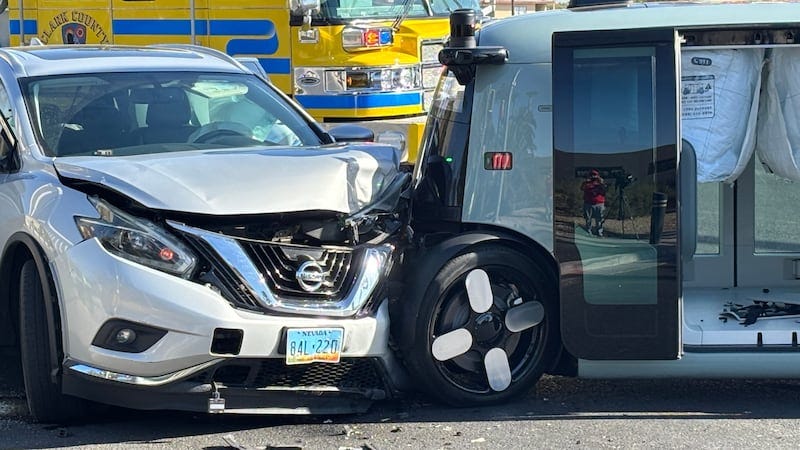
Source: Fox5 Vegas
Little is known so far. Here is what the Nevada Highway Patrol and police confirmed:
Nobody was inside the Zoox at the time of the crash
The driver of the Nissan was taken to hospital with a minor upper-body injury
Lanes two through five southbound were closed for towing and the investigation
Nothing has been said about the cause or about who was at fault. The timing is worth noting, though: the Nevada permit capping Zoox at 100 robotaxis in the state expired on the same day.
Zoox’s crash had nobody inside. Tesla’s problem in Europe is the reverse: a system that needs somebody inside, and a regulator deciding how much that person should have to catch.
Tesla FSD sped in more than half of Brussels’ 30 km/h zones
Johanna.be, a Brussels non-profit that campaigns for pedestrian and cyclist safety, published its “FSD30” study this week. Its testers spent three days in July driving about 400 km with Tesla’s Full Self-Driving (Supervised), mostly on the low-speed streets where people on foot and on bikes are most exposed.
The findings:
FSD exceeded the limit in 55% of the 30 km/h segments tested, averaging 44 km/h where the legal limit is 30
It exceeded the 20 km/h limit in 42% of the “woonerven” (residential shared streets)
In the majority of 30 km/h zones, the car’s screen showed a 50 km/h limit
It repeatedly tried to overtake cyclists in “fietsstraten” (cycle streets), where Belgian rules do not allow cars to pass cyclists at all
Why 44 versus 30 matters: Johanna cites WHO data showing that a pedestrian hit at 44 km/h is nearly six times more likely to die than one hit at 30 km/h. That is why Brussels made 30 km/h the default across most of the region in 2021.
To be fair to the system, Johanna also credits FSD with yielding to pedestrians and cyclists, often earlier than it had to. And Johanna is an advocacy group with a clear mission, which is worth knowing when you read the study. But its findings are specific and measurable. The group sent them to the Dutch RDW and the Flemish mobility ministry on 7 September and asked both to reconsider their approvals.
The Flemish government’s response: the system is “learning,” and drivers remain “100% responsible.” Tesla did not respond.
Two different problems
There are two things in this study, and I think it is important to keep them apart.
The first is Tesla’s argument. Tesla has published its own study claiming FSD vehicles “do not speed excessively” and match the speed of surrounding traffic. So the defence is that FSD speeds about as much as the humans around it. That is a design choice, and regulators can argue about it. I don’t find it a convincing argument, for a simple reason: the whole promise of automated driving is to drive better than the average human, and copying the average human’s worst habit runs against that promise. And Brussels lowered its limits precisely because humans were driving too fast. A system that matches their speed reproduces the problem the city was trying to fix.
The second is Johanna’s finding. In most of the 30 zones, the car displayed 50. A car that shows 50 in a 30 zone did not know the limit, so deliberate traffic-matching cannot explain it. That is a capability gap, and it is harder for Tesla to argue away than the first point, because it does not depend on anyone’s view of what speed is acceptable.
This is the first time an independent group has taken the system into the environment European regulators care about most, dense streets full of pedestrians and bikes, and published what it found.
Where Tesla stands in Europe
The Dutch RDW granted FSD (Supervised) a provisional approval under UN Regulation 171 in April. Since then, Denmark, Belgium, Estonia, Lithuania, Slovenia and, as of this week, Czechia have recognised it nationally. Flanders signed off on 10 June after Tesla completed 5,000 km of supervised testing on Flemish roads.
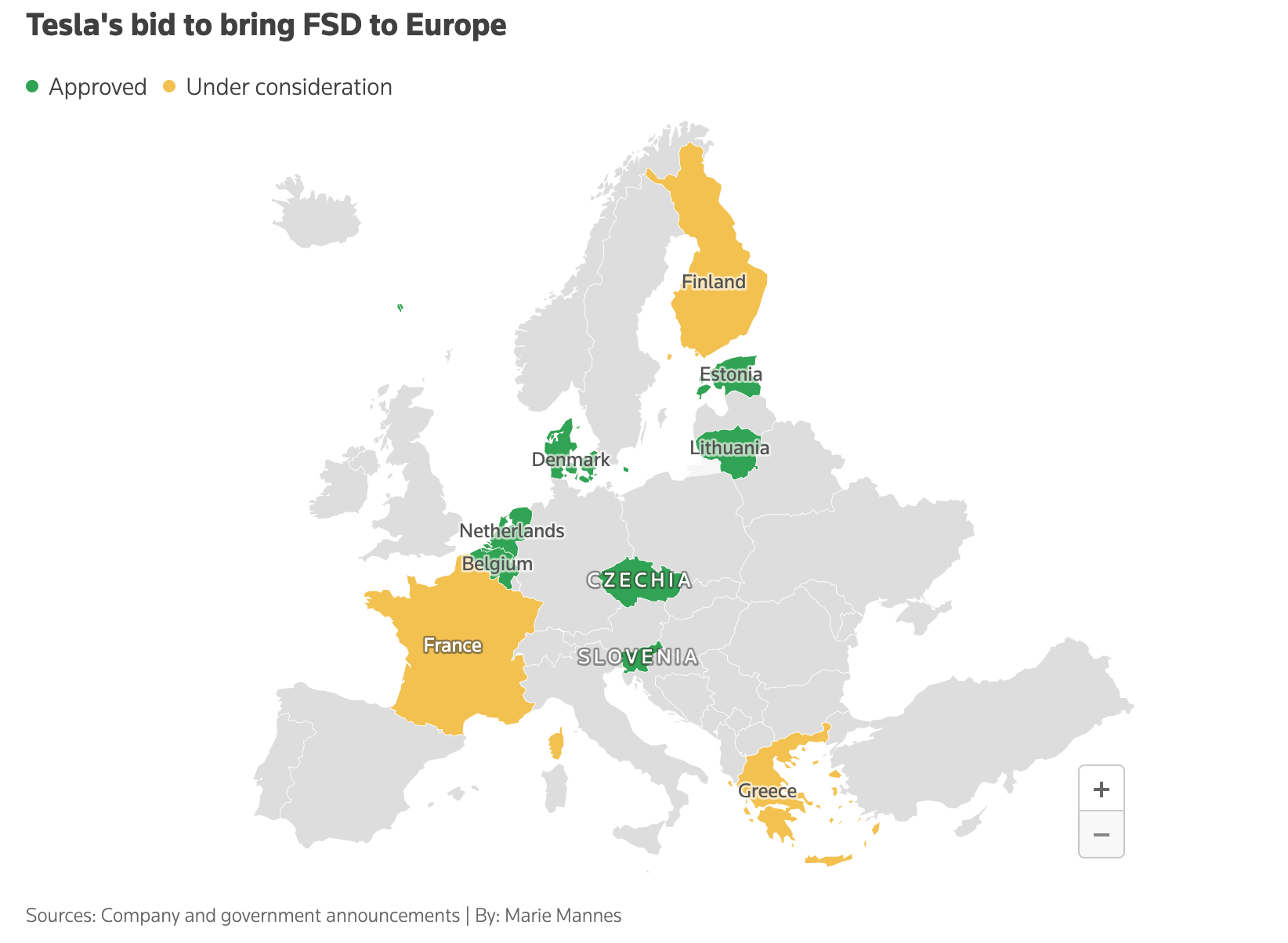
Source: Reuters
But national recognitions are a patchwork. What Tesla needs is EU-wide approval. For that, the Technical Committee on Motor Vehicles (TCMV), where member states and the European Commission sit together, has to vote in favour, and the Commission would then extend the RDW approval to all 27 member states. The vote needs a qualified majority: at least 15 of the 27 member states, representing at least 65% of the EU’s population.
And speeding has been the main obstacle all along. In June, Sweden told the EU to reject FSD unless Tesla removes its ability to exceed speed limits, and Norway and Finland raised the same concern. A month later, France refused to recognise the Dutch approval, with Transport Minister Philippe Tabarot citing speeding and driver attention in cities. A study showing systematic speeding in city 30 zones lands exactly on the objection these countries already raised.
The EU vote slips to December
In CW38 we flagged 6 October as the dated gate to watch, after Tesla said an EU-wide vote could come that day. It won’t.
Reuters reported on Friday that the published agenda for the 6 October TCMV meeting lists only a “continuation of discussions” on the Dutch request, with 25 minutes allocated. The committee has already discussed Tesla’s request at two previous meetings. The next scheduled TCMV meeting after October is in December, which makes December the earliest realistic date for a vote. The RDW told Reuters it would not speculate. Tesla did not respond.
Some context on what a yes would take. France alone accounts for roughly 15% of the EU’s population. Under the EU’s voting rules, a blocking minority needs at least four member states representing more than 35% of the population. France would need partners representing more than another 20% of the population. And by December, the committee will have discussed the request at three meetings without a vote.
It is not impossible. The same committee approved Ford’s BlueCruise driver assistance system in March 2024, with Germany as its sponsor. But BlueCruise did not arrive with an independent study showing it speeding through city 30 zones before the vote. Tesla has called FSD approval key to regaining market share in Europe, where it faces growing competition from Chinese EV makers. It now has until December, and I suspect the cheapest route to a qualified majority is the concession Sweden asked for in June.
One more US story this week, and it comes from a German company.
MOIA America launches its first US passenger service in Orlando
Volkswagen’s MOIA America has started carrying passengers in Orlando’s Lake Nona community, together with the autonomous mobility operator Beep. It is MOIA’s first passenger operation in the US.
How it works:
Riders book through the Beep app and use dedicated pickup and drop-off points along three routes in Lake Nona
The vehicles are self-driving ID. Buzz vans running a self-driving system developed by Mobileye
In this phase, human monitors ride on board
The integrated system is designed for fleet operators to deploy and manage autonomous services
Florida is one of the most permissive US states for autonomous vehicles and has allowed companies to operate without a human safety driver on public roads for years. MOIA America is also testing and validating in Los Angeles and Austin before launching commercial operations there.
The context from last week matters here. In CW39, we covered Volkswagen’s search for MOIA co-investors collapsing after Uber and Lyft both walked away, with a possible write-down in the billions on the table. One week later, MOIA has passengers in Florida. There are two ways to read the timing. It could be a proof-of-life signal for any investor still looking. Or it could be a sign that the US unit is becoming the more saleable part of MOIA. I genuinely don’t know which it is.
The partners are also familiar from recent issues. In CW38, Mobileye led Beep’s Series B, and last week Beep merged with Freebee, the human-driven microtransit operator. So in Orlando, a Mobileye-backed operator is running Mobileye-driven vehicles for Volkswagen.
I am curious whether we see MOIA take the driver out in America before it does so in Europe. But I think the question is less about Florida versus Hamburg than it first looks. Florida’s rules were never the constraint; it has allowed driverless operation for years. The vehicles in Orlando, in Hamburg and, as you will see in Quick Takes, in the new KIRA+ project in Hesse all run on Mobileye’s system. And as we wrote last week, I am not aware of a single deployment where Mobileye has taken the safety operator out. Whether MOIA goes driverless first in the US or in Europe depends more on when Mobileye is ready than on which regulator says yes.
What this means and what to watch
First, the transit question will be settled by data from the stations. The credit will mostly reward trips riders would have taken anyway. The staging spaces at Caltrain are the part that could create trips transit cannot serve alone. Watch whether Waymo brings staging to other regional rail systems, and watch whether a transit agency, rather than Waymo, starts paying for the connection.
Second, the Ojai is now arriving in volume, and Texas shows where. With MoffettNathanson projecting 5,100 by year-end against a national fleet of about 4,000 today, the question for the next quarter is how fast those vehicles reach paying riders. Florida and Las Vegas are the next places to look.
Third, teen accounts are a trust product, and the rollout speed tells you how confident Waymo is in its own record. If the next teen cities are markets that opened within the last year, “mature operations” is being redefined in real time. Watch for them in the coming months, and watch for the first incident report involving a teen account, because it will get more attention than any adult ride.
Fourth, Waymo’s safety data sets the standard for the whole industry. It is updated in line with NHTSA’s reporting timelines, with a method others can check. The next milestone is a fatality-only comparison, which Waymo says it will publish when it has the miles. Every competitor will be measured against this hub, and “we publish our own study” will become a harder answer to give.
Fifth, the human layer is becoming a story in its own right. Atlanta is about workers inside test cars, and it will not be the last of these stories as fleets grow. For Zoox specifically, the number to watch is still a published paid ride count in Las Vegas, now that the state cap is gone.
Sixth, Tesla’s European path runs through the speed-limit question, and December is the next gate. The binary to watch: does Tesla offer an EU configuration that cannot exceed posted limits? If it does, the Swedish objection falls away and a qualified majority becomes plausible. If it does not, the Brussels study will be on the table at every meeting.
Seventh, watch Mobileye. MOIA’s driver-out date in Orlando will be Mobileye’s driver-out date.
🔗 Electrek / Electrek (2) / Electrek (3) / The Verge / Autonomy Insiders EP14 / TechCrunch / TechCrunch (2) / TechCrunch (3) / FOX5 Las Vegas / Reuters / Reuters (2) / Waymo / Texas AV Tracker
Enjoying the AV Market Strategist?
If you find value in these deep-dives and enjoy the updates on autonomy each week — you can support my work.
Your contribution helps me access better data sources, industry reports, and research tools to keep every issue sharper and more insightful.
The newsletter will always remain free to read, whether you choose to support or not — but every bit of backing helps me make it even better.
Europe keeps a human responsible: Wayve signs Mercedes, Switzerland starts charging, Bulgaria orders robotaxis
Europe’s week was about keeping a human responsible. Mercedes chose Level 2, Switzerland kept its safety drivers, and the only fully driverless promise came without a date.
Wayve and Mercedes-Benz sign a definitive production agreement
Wayve and Mercedes-Benz have signed a definitive production agreement to integrate the Wayve AI Driver into future Mercedes-Benz vehicles. That puts it a step beyond the memoranda of understanding and technology studies that fill most announcements in this industry.
What Mercedes is buying:
The system: “advanced urban point-to-point driving assistance,” covering city streets and highways
The timing: starting within the next two years; the FT reports it will go into at least one Mercedes model in that window
The level: Level 2. The driver has to monitor the system at all times
The integration: Wayve’s software already runs on Mercedes’ own hardware, its MB.OS operating system and its map interfaces, and has been demonstrated in Stuttgart, London and San Francisco
The agreement builds on a multi-year technical partnership and on Mercedes’ strategic investment in Wayve’s Series D earlier this year. Jörg Burzer, Mercedes’ CTO, called it “the world’s first integration of the Wayve AI Driver in the premium segment.”
To be clear: this is not a robotaxi deal. Wayve’s current system is Level 2 driver assistance that, like Tesla’s, relies primarily on cameras and compute, which keeps it affordable. But “point-to-point” is the important phrase. The system is meant to handle the whole trip, city and highway, with the driver supervising, which is a meaningful step beyond lane keeping on a motorway.
Three OEMs, and a vote of confidence
Mercedes is Wayve’s third carmaker. Nissan and Stellantis already had partnerships, and all three carmakers backed Wayve in its funding round in February. For a start-up whose pitch is that one AI driver can generalise across vehicles, cities and brands without city-specific retraining, a third OEM signing a production contract is the strongest evidence yet that carmakers believe it. Alex Kendall, Wayve’s CEO, told the FT that automakers have gone “from a year ago being almost sceptical... to now a deep belief that this technology works.”
And remember the MOIA story from last week? Manager Magazin reported that Volkswagen quietly started shadow-mode test drives with Wayve a year ago, and that Cariad, after breaking off its cooperation with Bosch, counts Wayve among its favourites for a new technology partner. So if Volkswagen and MOIA sign a new technology provider, and that provider turns out to be Wayve, Wayve would have its fourth OEM deal. At that point, it would be close to becoming the default choice for carmakers that would rather buy their driving AI than build it.
Why Level 2 is where this sells first
Here is what I think is the most important part of this deal, and it connects straight back to the Tesla story.
At Level 2, the driver remains responsible. At Level 3 and above, responsibility shifts towards the manufacturer while the system is driving. Mercedes knows this better than anyone: it was the first carmaker with an approved Level 3 system, Drive Pilot. As we logged in CW4, Mercedes paused Drive Pilot on cost and demand. In CW23 we covered MB.Drive Assist Pro, a Level 2 system with wider urban coverage, taking its place, with Momenta supplying the software in China and NVIDIA in the West. Wayve now joins them. Mercedes is not retreating from automation. It is choosing the level at which the driver keeps the liability.
Grayson Brulte made the same point on The Road to Autonomy this week: “when you call it L2 or L2+… your insurance liability costs go down because L3 is a can of worms when it comes to insurance.”
And this is precisely why an end-to-end AI driver like Wayve’s can go into a premium car before it goes anywhere else. That brings us to Nissan.
Nissan’s two camps
The FT reported that inside Nissan, which plans to combine Wayve’s software with its ProPilot system and to supply fully autonomous vehicles running Wayve’s system for Uber’s robotaxi services, there are two camps. One enthusiastically embraces Wayve’s technology. The other worries that the AI operates as a black box, creating liability issues. Nissan’s engineers are separately developing their own Level 4 system in-house.
A former senior Nissan executive told the FT that a rules-based approach would still be needed for more advanced autonomous driving, because the reason for an accident caused by a car running Wayve’s system “could not easily be identified.” Kendall pushed back, saying there are tools to measure performance and validate capabilities, and that the technology complies with existing regulations. “It will scale to a much greater degree than what a single automaker can do with an AI they try to build themselves. It’ll be… ultimately safer because of that model.”
Put the two stories together and the logic becomes clear. The black-box concern bites hardest where the manufacturer carries the liability. At Level 2, the driver carries it, so the question of why the system did something matters less legally. That makes Level 2 the natural entry point for end-to-end systems, and it is why Wayve’s first premium contract is a Level 2 contract. The harder question, explaining an AI’s decisions when nobody is supervising, arrives with Level 4.
Two ways to read it
Read optimistically, Wayve now has three OEM programmes to deliver. According to Rob Grant on The Road to Autonomy, Nissan’s ProPilot integration is expected from the fiscal year starting April 2027, Stellantis’ hands-free system in North America in 2028, and now Mercedes within two years. Deliver all three, and Wayve will have proven something no one else has: a reusable driving-software business that works across unrelated carmakers. Grant called it “the broadest independent software provider with the largest footprint in Europe.”
Read skeptically, the substance is narrower than the framing. The Road to Autonomy’s own analysis noted that the announcement names no model, no market, no launch year and no financial terms. And Mercedes is running automated-driving software as a portfolio of suppliers, which the FT describes as a common hedge across the industry: different partners in different regions, plus in-house development. A carmaker with three software partners has not picked a winner yet. Grant also flagged the delivery risk: three integrations on different schedules can expose expensive customer-specific engineering, precisely what a generalisable AI driver is supposed to avoid.
I lean towards the first reading, but I hold it with a caveat. The deal matters more for Wayve than for Mercedes. For Mercedes it is one more option in a portfolio. For Wayve it is proof that its supplier model works in the premium segment. The real test is whether all three programmes ship on time.
The next news takes us to Switzerland.
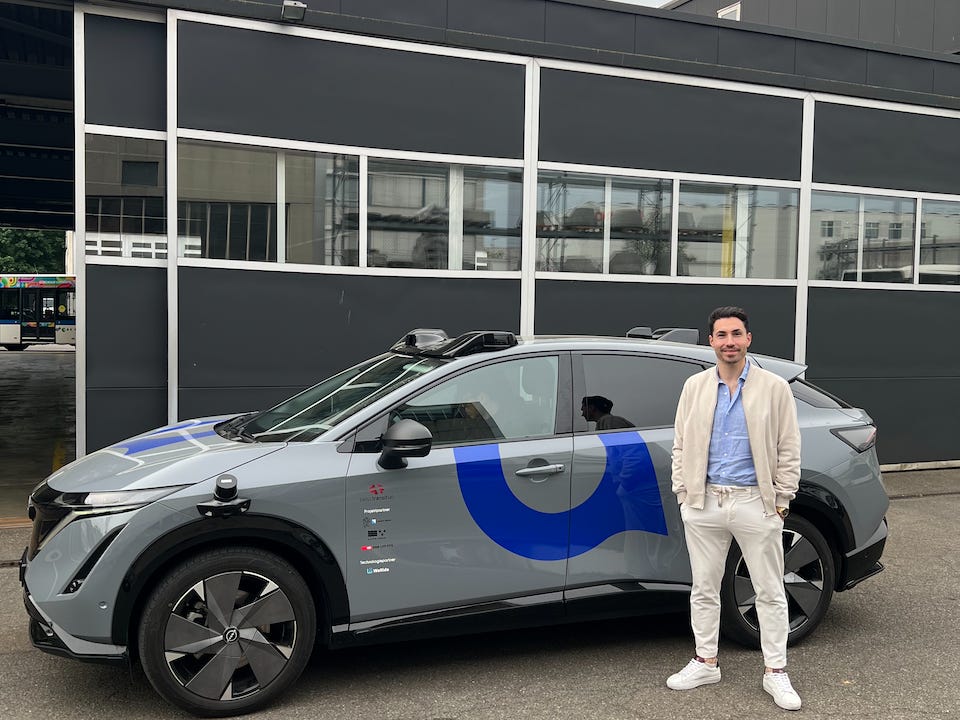
Switzerland’s first paid robotaxi rides (supervised) start on Monday
From 28 September, the “iamo” pilot (intelligente automatisierte Mobilität) in the Furttal, north-west of Zurich, opens to the public. The partners say it is the first time in Switzerland that passengers can book and use self-driving vehicles, and they will pay a fare to do it.
Who is behind it:
Swiss Transit Lab, which leads the project
Canton of Zurich (economic affairs directorate) and Canton of Aargau (department of construction, transport and environment)
SBB, the Swiss Federal Railways
WeRide, as technology partner
How the service works
Vehicles: three passenger cars driving in self-driving mode in regular traffic
Safety: a safety person sits in the driver’s seat; the front passenger seat stays empty for safety reasons
Area: almost 100 predefined stops across four municipalities: Boppelsen, Dänikon, Hüttikon and Otelfingen
Booking: via the iamo app; up to three passengers per car are picked up at the stops and taken to their destination within the operating area
Hours: daily, from 13:00 to 17:00, to start with
Age: from 12 years alone; younger children only with an adult
Price: a base fare of CHF 4.70 plus CHF 0.38 per kilometre
Because it is a pilot, the service is not integrated into the Swiss public transport tariff system. General and other public transport passes are not valid.
Why the Furttal, and what the pilot is for
The goal is to show how automated vehicles can extend public transport where conventional services reach their limits, in off-peak hours or in thinly populated areas, especially on the first and last mile. The Furttal was chosen for its mixed settlement structure, its size and its existing network built around a central S-Bahn line. SBB’s Matthias Bütler put the logic plainly: rail stays “the backbone for medium and longer distances,” while self-driving vehicles bring travellers to the station or home over short distances.
How we got here, and where it goes next
End of 2024: the pilot starts, designed to run for up to five years
Summer 2025: the first two vehicles drive the Furttal manually, building a high-precision digital map of the region
November 2025: ASTRA grants approval for automated driving. Since then, up to three vehicles have been driving in self-driving mode in regular traffic, always with a safety person behind the wheel, at different times of day, in different weather and traffic conditions
28 September 2026: public passenger service starts
Next, the fleet is supposed to add minibuses, and those are meant to run without a safety person on board, remotely supervised by trained staff at Eurobus’ central control room. That step needs another approval from ASTRA. The current passenger cars, by contrast, will keep a safety person for the entire passenger phase. The partners say driverless operation with these prototype vehicles would take too much effort, so the project is putting its energy into the minibuses.
I rode in the iamo vehicles in May, during the Automated Mobility Summit in Zurich, and it is good to see them carrying paying passengers now.
Switzerland keeps building its lead
iamo is one piece of a larger picture. Switzerland is steadily turning into one of Europe’s most active testbeds for autonomous mobility:
Zurich Airport: WeRide-equipped employee shuttles now run without a safety person on board, monitored from a control room, as we covered in CW38
Zurich, robotaxis on Uber: WeRide and Uber announced Zurich in June, with the local operator Rydera running ground operations. WeRide’s Eric Dong said fare-charging rides should start around December with safety drivers, on roughly 12 vehicles and at prices comparable to Uber’s regular offering, with a driver-out target of mid-2027
Eastern Switzerland: PostAuto runs Baidu’s Apollo Go vehicles hands-free (with a safety driver) under a special permit across St. Gallen and Appenzell, with passenger service and up to 25 driverless vehicles planned for 2027
Zurich: Waymo registered a Swiss entity this summer, which we covered in CW33
The rulebook: the Swiss ordinance in force since March 2025 allows driverless Level 4 operation under remote supervision, with the supervisor based in Switzerland
Switzerland has a clear regulator, a railway that wants feeders, cantons that fund pilots, and a pragmatic approval process. None of the passenger projects on that list runs on a European technology stack yet. And one name keeps coming up: WeRide is behind iamo, the Zurich Airport shuttles and the Uber service in Zurich. In Switzerland, WeRide now has three bets in play, each on a different business model: a public transport feeder with the railway, an airport shuttle, and a ride-hailing robotaxi.
Tensor and Volt Premium Taxi plan Bulgaria’s first robotaxi fleet
Volt Premium Taxi describes itself as Sofia’s premier transport service and the region’s leading upscale transport provider, serving discerning passengers and corporate clients. Its founder is Oggy Popov.
This week Volt announced a partnership with Tensor, the Silicon Valley company behind the Tensor Robocar, to deploy what the companies call Eastern Europe’s first fully autonomous robotaxi fleet.
The key points:
Initial order: 200 purpose-built Tensor vehicles
Long-term goal: ordering and deploying up to 2,000 vehicles across the region
Rollout: starting in Sofia, with plans to scale into adjacent regional markets
Operations: Volt will build and manage the service, maintenance and support infrastructure for the robotaxis in Sofia itself
Technology: Tensor’s Level 4 system with full-stack redundancy, with compute from partners including NVIDIA, Oracle and Arm
Popov framed it as “an entirely new ecosystem for premium, driverless mobility in Eastern Europe.”
Premium fits Tensor
The premium branding fits Tensor well. Tensor’s flagship product is a personal Robocar built for private ownership, positioned as a luxury, privacy-first vehicle. Its founding pitch, which we covered in August last year, was a car with 37 cameras and 5 lidars that you own and that drives itself. A company whose product is designed around the expectations of individual premium buyers is a natural match for a taxi brand selling comfort and privacy to corporate clients.
Volt is not Tensor's first fleet customer. Lyft committed to buying hundreds of Robocars, and GreenMobility in Denmark announced plans for 2,000.
What the announcement leaves out
In CW34, we set a simple standard for European robotaxi announcements: named partners, a regulator, distribution, a fleet trajectory and a year. Volt and Tensor name the partners and give a fleet trajectory. They name no regulator, no launch year and no price.
The release says regulatory frameworks are “currently being finalized at both the EU and local levels,” and in the same breath that “the road is clear.” Both cannot be fully true yet. There is also no public evidence so far of Tensor vehicles in commercial service anywhere, and the Lyft deliveries were only due to start late this year. The order book is running ahead of the product, so I would read this deal as early and treat the numbers accordingly.
What this means and what to watch
First, Level 2 is becoming the commercial home of end-to-end driving AI in Europe, because that is where the liability stays with the driver. Mercedes’ move from Level 3 Drive Pilot to Level 2 systems from three suppliers is a liability decision as much as a technology decision. Watch whether any European carmaker signs an end-to-end supplier for Level 3 or above. That would be the signal that the black-box concern has actually been answered.
Second, Wayve’s challenge has moved from winning contracts to delivering them. The dates to hold it to: Nissan from the fiscal year starting April 2027, Stellantis in North America in 2028, Mercedes within two years. And watch whether Volkswagen’s reported shadow-mode drives with Wayve turn into its fourth OEM deal. That would bring Wayve close to becoming the default choice for carmakers that would rather buy their driving AI than build it, but it would also add a fourth integration running in parallel.
Third, Tensor’s next test is delivery. Watch whether the first Robocars reach Lyft on schedule late this year. Until vehicles are in commercial service somewhere, Volt’s 200 and GreenMobility’s 2,000 are intentions. And for Sofia specifically, the missing piece is a date and a regulator.
🔗 Wayve / Financial Times / The Road to Autonomy / iamo / Volt Premium Taxi
💡 Quick Takes
Aurora wants 200 driverless trucks by year-end and positive free cash flow by 2028
Aurora took CNBC on a three-hour ride in a driverless semitruck on I-45 between Houston and Dallas. Aurora runs 20 driverless trucks today, on I-45 and on I-20 between Fort Worth and El Paso, and plans to reach 200 by the end of the year. After losing more than $800 million in 2025, it is targeting positive free cash flow in 2028. The economics case in one comparison: Bank of America estimates Aurora’s service will cost about $0.85 per mile, against roughly $1.30 per mile for driver wages and benefits alone, before indirect labour costs. Morgan Stanley’s Ravi Shanker goes further and estimates an autonomous fleet should be nearly 7.5 times as profitable as a human-driven fleet today.
🔗 CNBC
Einride builds its next autonomous truck on NVIDIA Hyperion
Einride will build the next generation of the Einride Driver on NVIDIA’s DRIVE Hyperion platform, working directly with NVIDIA to adapt the platform’s compute, sensors, software and safety architecture for heavy-duty trucks. Einride keeps ownership of the driving system, including safety validation and regulatory approval, while NVIDIA supplies the compute platform and AI tools, including Cosmos for edge-case search and synthetic data.
🔗 Einride
RMV, Deutsche Bahn and HOLON start KIRA+ in the Rhine-Main region
The Rhine-Main transport association (RMV), DB Regio and HOLON have launched KIRA+, a project to test autonomous on-demand public transport in Darmstadt and the district of Offenbach, with the goal of preparing a model region where autonomous vehicles become part of the regular service. The vehicle is the accessible HOLON urban, fitted with Mobileye’s self-driving technology, with five passenger seats and a wheelchair space. First mapping drives start during 2027, bookings will run through an ioki app, and safety staff will be on board for the trips. DB Regio operates the service, including technical supervision; HOLON holds the vehicle permits. It is HOLON’s third German region after Hamburg and Paderborn, and KIRA+ is one of five test fields in the federally funded MILA.mobility project. Note the supplier: Mobileye again, as in MOIA’s Orlando and Hamburg services.
🔗 RMV
UISEE and Lufthansa plan Level 4 autonomous driving at Munich Airport
Shanghai-based UISEE has signed a strategic partnership with Lufthansa to launch a Level 4 autonomous driving project at Munich Airport. The deal was unveiled at the GSE Expo Europe in Lisbon and covers intelligent ground operations and the digital transformation of airline operations. UISEE CEO Wu Gansha said the company will use its proven Level 4 products and operating systems to explore tarmac automation within an international airline framework. It is a Chinese autonomy stack entering the ground operations of Europe’s largest aviation group, at one of Europe’s largest hubs, one week after ALVEST bundled EasyMile and TractEasy into TLD Robotics at the same trade show.
🔗 Gasgoo
SATS tests autonomous cargo vehicles at Changi
SATS is validating autonomous cargo vehicles to move freight between its airfreight terminals and freight forwarders’ warehouses inside the Changi Airport free trade zone. The vehicles are built by Zelostech, with Eevie Transport Solutions as systems integrator. Another airport, another closed logistics loop where autonomy can prove itself before it meets public roads.
🔗 Aviation Week
SoftBank puts $225 million into autonomous construction with ASI
Autonomous Solutions (ASI), the developer behind the Mobius fleet orchestration system, has formed a joint venture with SoftBank to develop and commercialise autonomous construction equipment for large infrastructure projects. On top of the joint venture, SoftBank Group invested $225 million directly in ASI. The pitch is OEM-agnostic: mixed fleets of haul trucks, dozers, loaders and compactors from different manufacturers operating autonomously together, from earthmoving to vertical construction.
🔗 Robotics & Automation News
Waabi drove Dallas to San Antonio without any route-specific training
Waabi says its autonomous driving system completed the Dallas to San Antonio freight corridor fully autonomously, with no disengagements, without collecting new real-world or simulated data for the route and without any route-specific fine-tuning. Waabi calls it a “zero-shot” run: a geography the system had never encountered. It follows an earlier zero-shot milestone on the Volvo VNL Autonomous, where Waabi deployed its driver without vehicle-specific retraining despite different truck dimensions, sensor positions and vehicle dynamics. Why this matters commercially: every new lane has traditionally meant its own cycle of data collection, adaptation and road testing, while freight networks shift with contracts, customers and seasons. If a driver generalises across routes and vehicles, adding a lane stops being an engineering project. It is the same promise Wayve makes for cities, applied to highways, and like Wayve’s, it will ultimately be judged on commercial lanes. These are company-reported results.
🔗 Trucknews
Applied Intuition partners with Echelon to deploy physical AI across Saudi Arabia
Applied Intuition has formed a business development partnership with Echelon, a Riyadh-based technology company founded by Khalid Bin Bader Al Saud, to bring its physical AI platform to Saudi Arabia at national scale. Target industries include robotaxis, trucking, ports, mining, manufacturing, agriculture and construction. Echelon provides local development, customisation and ecosystem integration and embeds forward-deployed engineers with customers. Applied Intuition has opened a regional office in Riyadh and is hiring locally, and the two companies want to position the Kingdom as a global research hub for autonomous driving in logistics. This is Applied Intuition’s second Saudi move in a month. In CW37, we covered its collaboration with PIF-owned HUMAIN to deploy thousands of autonomous trucks across Saudi logistics corridors by 2030. The pattern is clear: the Kingdom wants the technology built and operated locally, and Applied Intuition is building the local partner network to do exactly that. Qasar Younis, Applied’s CEO: “Saudi Arabia is making one of the world’s biggest investments in physical AI.”
🔗 Dealroom
Kodiak starts hauling produce in California under the state’s new heavy-duty permit
Kodiak has launched a pilot with DTL Transport, a Fresno-based carrier that runs cross-country team hauls of produce for some of the largest US grocers. Since 22 September, Kodiak’s trucks have been moving time-sensitive, perishable goods about 225 miles between Fresno and a distribution center in Los Angeles, mostly on State Route 99 and Interstate 5. It is possible because California’s DMV approved rules on 28 April that allow heavy-duty autonomous trucks on the state’s public roads for the first time, and Kodiak received its testing permit on 13 August. That permit is only the first step of a phased approach, from driver-in testing to driver-out testing to driver-out deployment, so a safety driver stays behind the wheel for now. Kodiak’s own target is driverless operations on Texas public highways by the end of 2026.
🔗 GlobeNewswire
Neolix brings its robovan to Brussels
Chinese delivery-robot maker Neolix will trial a fully autonomous electric robovan on the streets of central Brussels by the end of this year, for parcel deliveries or collecting trash bags. Yong Gessner, Neolix’s head of Europe, told Nikkei Asia the goal is to learn how much time and effort European regulatory requirements take, then expand step by step across Belgium and into neighbouring countries. Neolix plans a European headquarters in Luxembourg, is looking at Portugal, France, the Netherlands and Switzerland, and is considering onshore production. The scale behind it: Neolix says it runs 27,000 autonomous vehicles in more than 320 cities across over 15 countries, with 230 million autonomous kilometres logged. It raised over $1 billion last year in a round led by UAE-based Stone Venture and is seeking a Hong Kong listing.
🔗 Nikkei Asia
🎧 Autonomy Insiders
London’s first robotaxi service runs on the Uber app with a safety driver still behind the wheel. Here is every step a company must clear before the UK lets it take the driver out.
Tym Syrytczyk co-founded the Institute for Driverless Transport (IFDT), an independent UK research body, and writes Self-Driving Insights. His recent piece on getting permission to run a robotaxi service in London is the plain-English explainer. This episode walks through it in order.
📚 Worth Reading/Listening
Harry Campbell: The Road to Driverless Robotaxis with Nuro Co-CEO Dave Ferguson
🔗 The Driverless Digest
📊 Weekly Performance
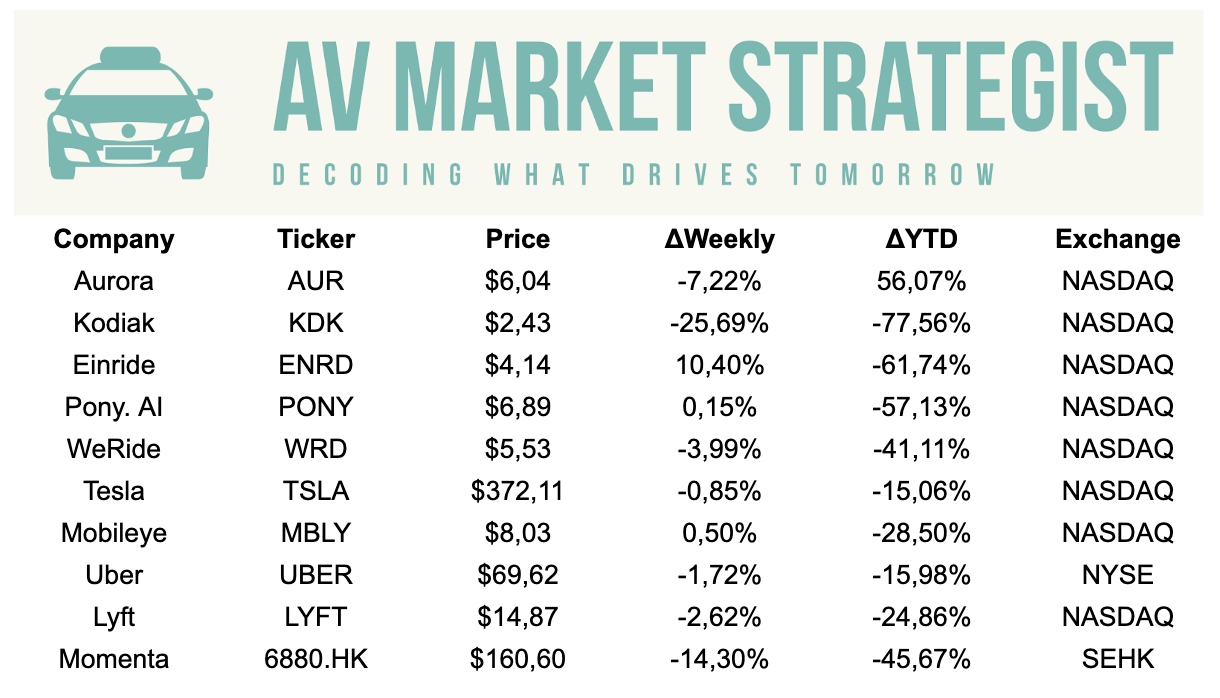
Note: Stock performance data as of September 27th, 2026. Past performance does not indicate future returns.
Thanks for reading!
If you found value in this newsletter, please consider sharing it with a friend or colleague who might benefit from these insights.
And if you haven’t already, subscribe to stay updated on the latest developments in the autonomous driving industry.
Disclaimer: This newsletter is provided for general informational and educational purposes only and is subject to change without notice. While we obtain information from sources we believe to be reliable, we do not guarantee its accuracy, completeness, or timeliness. We accept no responsibility for any actions taken based on this newsletter or for any losses resulting from its use. Nothing in this newsletter constitutes, or is intended to constitute, financial, investment, trading, legal, accounting, or tax advice. The content does not take into account your individual objectives, financial situation, or needs and must not be relied upon as personalized recommendations to buy, sell, or hold any security or other financial instrument. You should always do your own research and consult a licensed financial professional before making any investment decisions. Any opinions or views expressed in this newsletter are those of the authors at the time of publication and may change without notice. They do not necessarily reflect the opinions of any affiliated entities.
Still waiting for Elon's self driving Tesla...
The people riding in the test cars deserve as much care as the riders.