
👋 Welcome back everyone,
Big week, and a revealing one. Waymo started putting the public into the Ojai, its first vehicle built from the ground up for autonomy, with a body made in China by Geely’s Zeekr. Tesla went the opposite direction: its active robotaxi fleet shrank, and a Reuters investigation took apart the safety math behind the program. Pony.ai reported Q1/2026 earnings and as always, we will have a look at that.
Underneath all of this week’s developments runs one thread: Chinese hardware.
It builds Waymo’s new car, it sits inside Mercedes’ US problem, and it is scaling fast in Pony, WeRide, and BYD.
Let’s dive in!
⏱️ ~6000 words, 27 minute read

This newsletter is brought to you by Rocsys.
Rocsys M1 keeps robotaxi fleets moving, hands-free and at scale!
For self-driving vehicle fleets, hands-free charging isn’t just a nice-to-have. It’s the key to unlocking true autonomous mobility at scale.
Rocsys M1 is the first overhead rail-mounted charging solution that automates the charging process across multiple bays, enabling uninterrupted robotaxi operations.
A robotic arm picks up the connector, plugs into the EV, then moves on to serve another vehicle at a different bay, operating tirelessly 24/7. Vehicles charge seamlessly, reliably, and safely as soon as they return to the depot, maximizing uptime and throughput.
Personnel stay focused on higher-value tasks, while robotaxi operators scale quickly without impacting the bottom line.
Waymo’s new robotaxi, Tesla’s shrinking fleet, and new Texas AV data
Ojai: Waymo’s first car built to be a robotaxi
Starting in the next few weeks, Waymo will pick up members of the public in its new Ojai vehicles (pronounced “oh-hi”) across Los Angeles, San Francisco, and Phoenix. For now the rides are free. The Ojai is a pale blue, boxy minivan, and it matters for one reason: it is the first vehicle Waymo has deployed that was designed specifically for driverless operation rather than retrofitted from a car built for humans.
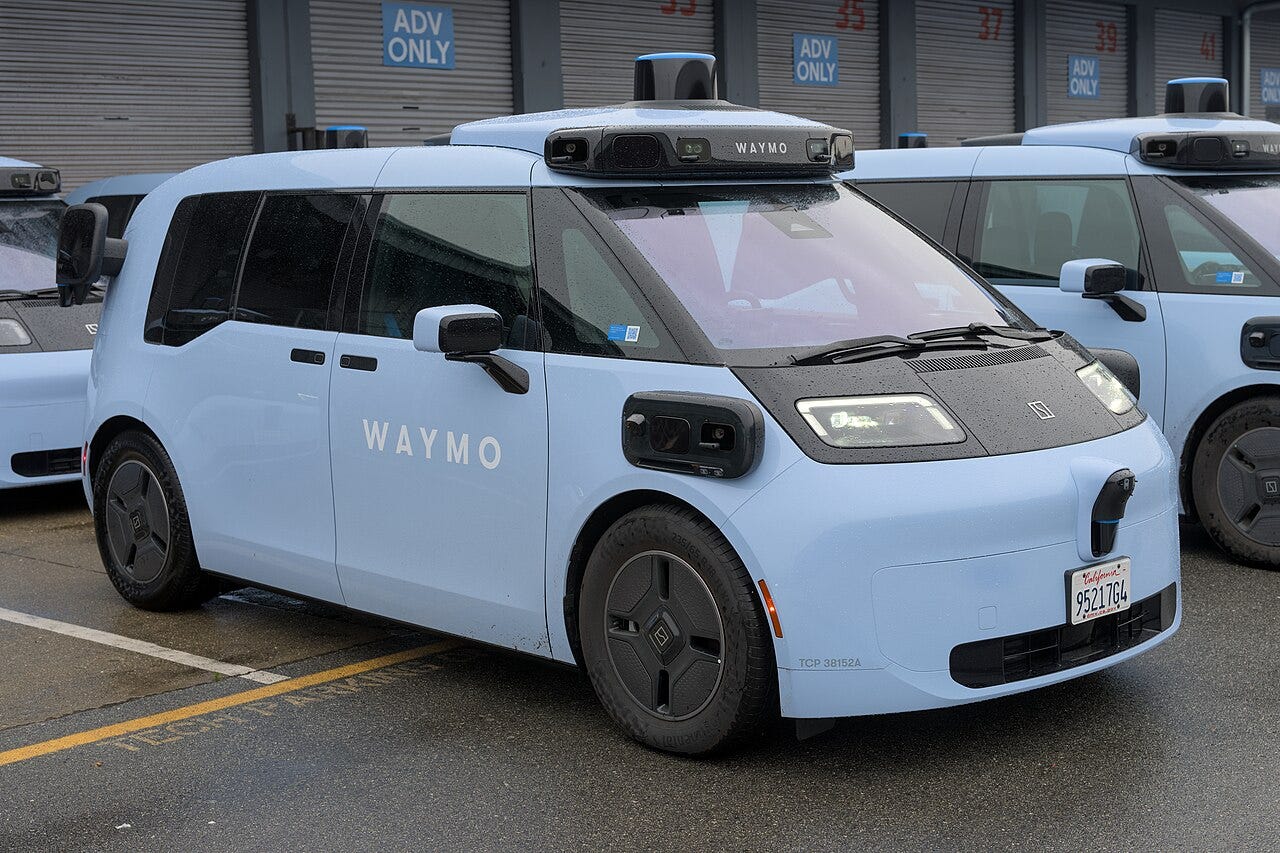
For nearly a decade Waymo ran its stack on vehicles meant for drivers. It started with the Chrysler Pacifica hybrid, then the Jaguar I-Pace in 2018. The Ojai breaks that pattern. Waymo and Zeekr partnered in 2021 and showed a concept in late 2022, then spent close to two years testing prototypes and a production-intent version on public roads. The vehicle carries Waymo’s sixth-generation system: 13 cameras, four lidar sensors, six radar units, and external audio receivers. That sixth-gen system is the commercial keystone because it is modular, designed to drop into multiple vehicle types. Two are announced so far, the Zeekr minivan and the Hyundai Ioniq 5.
The cabin is the rider pitch. Flat floor, low step-in height, gondola-style doors on both sides, charging ports, cup holders, grab bars, braille above the buttons, more head and leg room, and three large adaptive screens. Waymo says it is easier to clean, faster to charge, and modular enough to make repairs cheaper. The accessibility features are real, though the vehicle is still not wheelchair-accessible. Every one of those choices ties back to cost per mile and uptime, which is the only way robotaxi unit economics work at scale.
Here is the strategically interesting part: where the car comes from. The Ojai was designed in Sweden and manufactured in China, built on Zeekr’s SEA-M architecture, a version of Geely’s Sustainable Experience Architecture meant for future mobility products. The stripped-down vehicles, which carry no Chinese connected-car technology, are shipped to Waymo’s Arizona factory and fitted with the autonomous systems on US soil. Waymo says it is scaling toward capacity for tens of thousands of units a year, starting with the Ojai and followed by the Ioniq 5.
That capacity figure is the tell. The China-built body finished in Arizona on a modular kit is not framed as a cost experiment, it is the manufacturing engine meant to take Waymo from today’s roughly 3,700 vehicles to a fleet an order of magnitude larger.
But it also creates exposure. The Biden administration finalized rules barring Chinese-connected vehicle technology from US roads starting in 2027. Waymo says the prohibition does not apply because Zeekr only builds the base vehicle, with all telematics and software added in the US. That is a real legal distinction, but a thin political one. In a February congressional hearing, one Republican senator criticized the company for “getting in bed with China.” For most US riders, the Ojai will be their first ride in a Chinese-made car.
But why are rides free? Waymo spokesperson Sandy Karp writes that a period of gratis rides will help the company “gather rider feedback and continue refining the experience.”
But there is also another constraint. In California, Waymo has a permit to operate the driverless Ojai but not yet to charge fares in it. That sits with the California Public Utilities Commission, which has asked Waymo to address how it handles unaccompanied minors riding illegally and major disruptions like the late-2025 San Francisco power outage that stranded vehicles citywide. The CPUC will rule on the Ojai, and on a proposed expansion into the East Bay and parts of Southern California, by June 27. So the “free rides to gather feedback” framing is half true and half a regulatory holding pattern.
Waymo maps Virginia, and hits the same blue-state wall
The second move was quieter. Last week Waymo began transporting vehicles into Virginia to map Arlington and Alexandria. Self-driving cars are not yet permitted to operate in Virginia, and human drivers will run the mapping vehicles for now.
Waymo was careful with the framing. Spokesperson Ethan Teicher called it “an important preparatory step should the Commonwealth authorize fully autonomous ride-hailing,” while stressing the company does “not currently have plans for a commercial service there.” Policy adviser Rich Harrington told a Virginia Department of Transportation working group that moving from mapping to a robotaxi service takes 12 to 18 months and “a lot of money.” The state Senate is weighing a bill to license AVs for paying passengers, but its sponsor, state senator Saddam Salim, does not expect cars on the road before 2028.
The mapping push is really a lobbying play. Waymo carries paying passengers in 11 US metros, with plans for 20 more cities including London and Tokyo. Twenty-seven US states permit driverless taxi deployment and five more allow testing. The harder constraint is not technical, it is political, and it concentrates in Democratic-leaning states where labor unions and lawmakers worry about the hit to driving jobs. That is where Waymo has met its loudest opposition, and the important shift this week is that the same skepticism has bled outward into the cluster of jurisdictions surrounding Virginia, not just one isolated city.
Maryland’s legislature killed a bill last month that would have allowed driverless cars to carry passengers. A DC measure that would let AVs operate but hit them with their own bespoke permits and fees is still stuck in the city council. So the two jurisdictions that bracket Virginia, Maryland to the north and DC at its doorstep, have both pushed back within the last few weeks. That is the regional mood music against which Richmond is now drafting its own AV rules, and it makes Virginia’s path look less like a clean opening and more like the next front in a spreading blue-state fight. Waymo first signaled plans for Baltimore and DC back in 2025, and a year on the timelines are still vague.
The notable part is that the setbacks have not stopped the prep work. Despite the stalled DC measure and the murky Baltimore timeline, Waymo says it is still pressing ahead on a Washington launch and steadily preparing the ground for Baltimore. The Virginia mapping run is itself part of that same groundwork, laying digital track in a state that cannot yet authorize a single paid ride. The strategic logic is patience: do the expensive, invisible preparation now so that the moment a legislature flips from “no” to “maybe,” Waymo is months ahead of anyone starting from scratch. Putting cars in front of national policymakers across the DMV is also a way to shape the rules while they are still being written.
Tesla’s robotaxi fleet is shrinking, not scaling
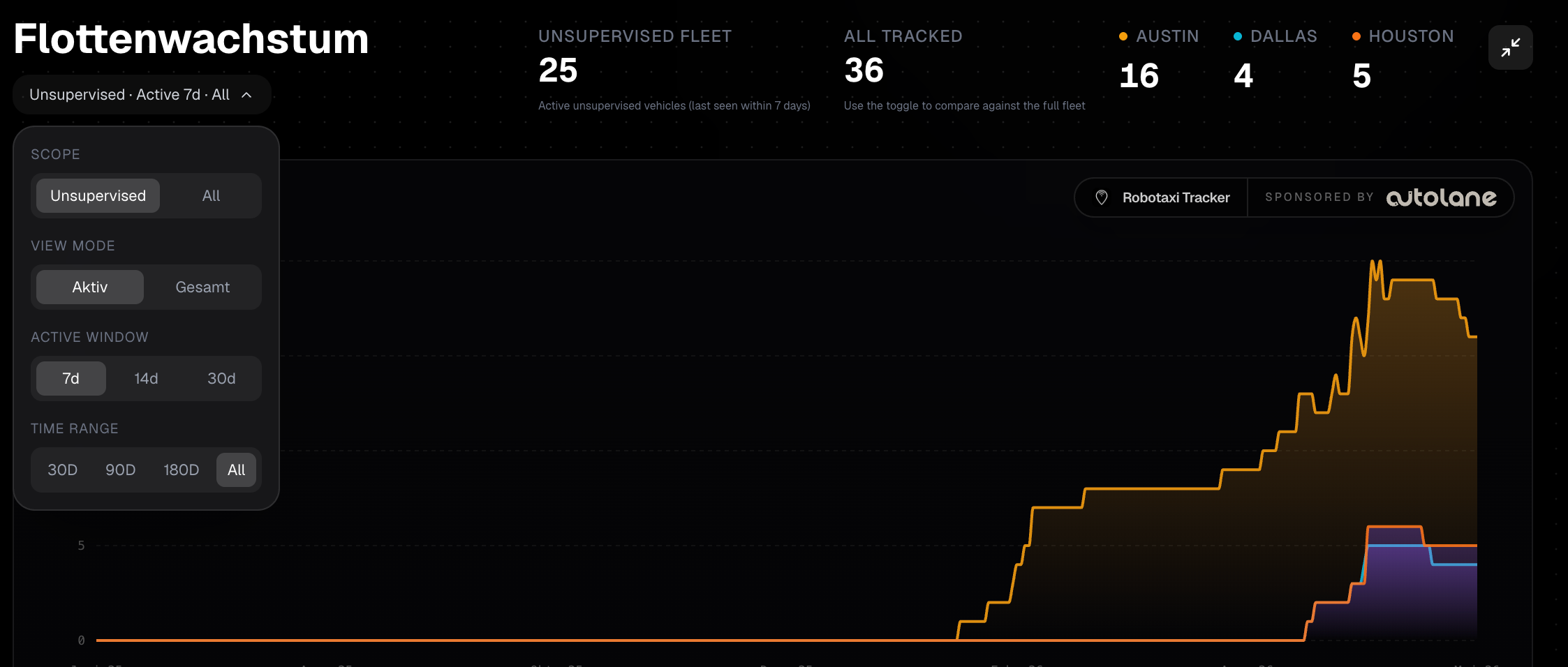
Now the contrast. Less than a month after early signs of growth, Tesla’s unsupervised robotaxi fleet is going backward. Data from the Robotaxi Tracker shows active unsupervised vehicles down to 25: 16 in Austin, 4 in Dallas, 5 in Houston. The unsupervised fleet peaked in late March and has declined since. Austin, the flagship, fell from 19 to 16. Dallas and Houston have not really grown since they launched in April.
Source: robotaxi tracker
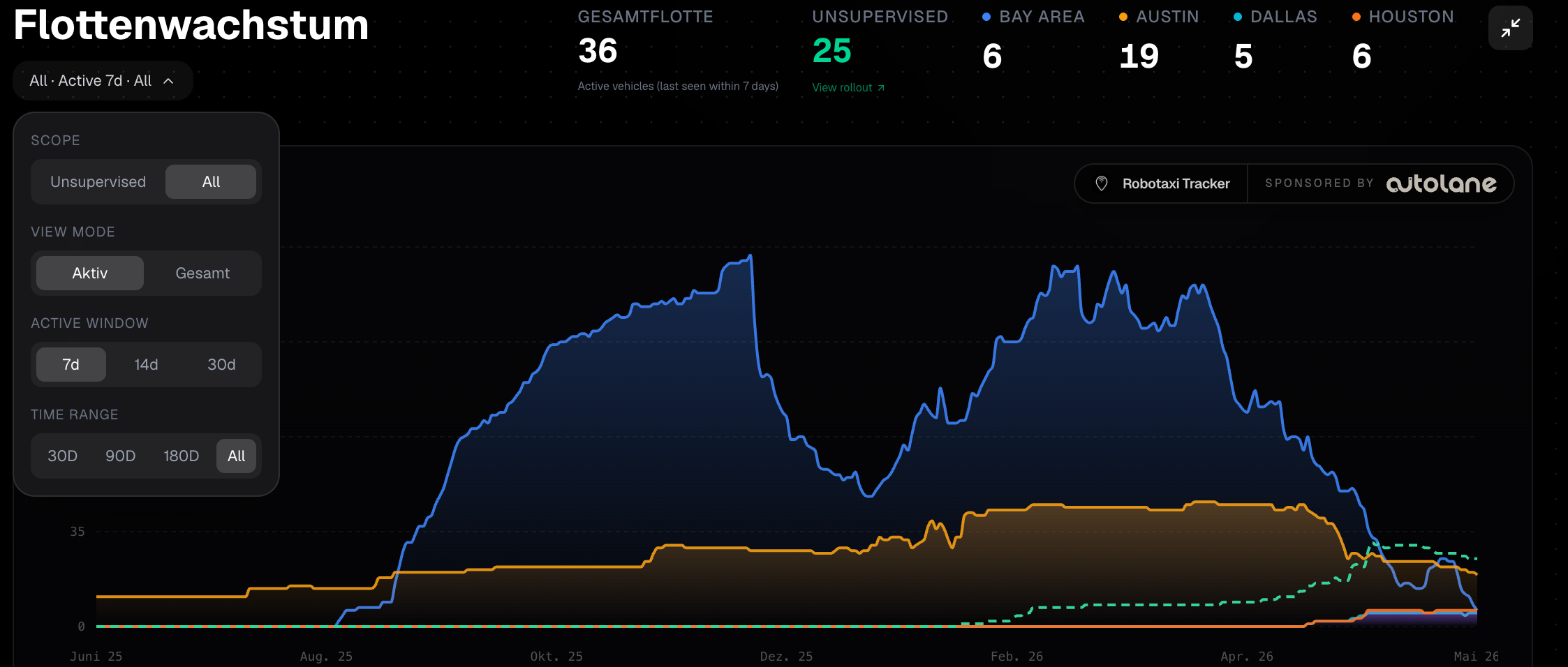
Zoom out to all of Tesla’s ride-hailing operations and it looks worse. The total active fleet is 36 vehicles. The Bay Area operation, which ran 107 of 165 active vehicles in April with safety drivers under California’s charter-party permit and was never truly driverless, has cratered to 6. The total count peaked around December 2025 and has fallen steadily since. A full year into the program, Tesla cannot sustain even 25 cars on the road.
Source: robotaxi tracker
The likely cause: safety is the bottleneck. Musk himself has said safety validation is the limiting factor, and Tesla’s unsupervised crash rate has been reported at roughly four times worse than human drivers. More vehicles mean more miles, and more miles mean more crashes, so Tesla appears to be pulling cars back rather than adding them. That is the right call for safety. It is a hard fact for the business case. Musk says he is waiting on the FSD v15 rewrite before scaling aggressively, which pushes the timeline to late 2026 or early 2027.
Set that against Waymo, which runs 3,791 robotaxis doing hundreds of thousands of paid trips a week. Tesla’s 25 unsupervised cars against Waymo’s thousands is not a gap that is closing. It is widening. Recall that just last week Musk told the Smart Mobility Summit that unsupervised FSD would be “widespread in the US by the end of this year”. The fleet data is the cleanest possible rebuttal.
The Tesla Reuters investigation: the safety math
A major Reuters investigation, based on nine former Tesla data labelers, a former self-driving engineer, and 11 traffic-safety researchers, hit two of Tesla’s central claims.
First, the safety statistics. Musk and other executives have said repeatedly that FSD is up to 10 times safer than human drivers. CFO Vaibhav Taneja first made the claim last July, Board Chair Robyn Denholm repeated it in November, and Musk showed a chart claiming “85% less crashes.” Reuters found a comparison error that inflated the figure by a factor of three. Tesla counted crashes where its own airbags deployed, then compared that to federal data covering all crashes requiring a tow, a far less severe threshold. The federal dataset already breaks out airbag-deployment crashes separately, so Tesla could have run an apples-to-apples comparison and chose not to. When University of Michigan researcher Marco Benedetti ran the correct version, “10 times safer” dropped to roughly three times farther between crashes, and even that is shaky given the fleet-age gap (Tesla’s fleet averages 4.1 years against 12.8 for the US fleet). Phil Koopman’s line: “It’s like saying my jet airplane is faster than your World War II bomber.” Ten of the 11 researchers called the stats misleading marketing rather than safety analysis.
The internal view is worse. Seven of the nine labelers said they would not trust FSD to drive them. The labelers, based in Utah, review footage from the eight exterior cameras and described FSD repeatedly failing at basics: pulling over for emergency vehicles, giving motorcyclists room, braking on freeway off-ramps, and handling construction zones, including one case where a Tesla nearly hit workers. After Tesla added a “Mad Max” mode, labelers saw the car exceed limits by 20 to 30 mph, including 60 in a 25 zone.
The legal backdrop is piling up. NHTSA has four active FSD and Autopilot investigations, including a probe of cases where FSD ran red lights or turned into oncoming traffic. Tesla took a $243 million verdict over an Autopilot crash in Florida that killed a 22-year-old woman. And its own FSD site still warns the features “require active driver supervision and do not make the vehicle autonomous.”
Texas pulls back the curtain on the real fleet counts
Until this week, every robotaxi fleet number was a company-supplied estimate. Texas changed that. A new state law that took effect on May 28 requires anyone testing or deploying autonomous vehicles in Texas to register with the Department of Motor Vehicles and disclose fleet size and safety information, and the DMV published it all on a public lookup tool. It is the first accurate, government-mandated accounting of who has how many vehicles on the ground.
The robotaxi leaderboard is lopsided. Waymo registered 577 autonomous vehicles in Texas. Avride follows with 317, then Zoox at 35, Nuro at 47, Tesla at 42, May Mobility at 18, and Volkswagen’s MOIA at 12. The headline is the gap between the two companies actually charging fares: Waymo’s 577 is more than thirteen times Tesla’s 42, and this is in Tesla’s home state, where its robotaxi program is headquartered. Recall that last fall Musk said Tesla would have 500 robotaxis in Austin alone by the end of 2025. The entire Texas fleet is 42, and the active-operations tracker I cited earlier puts the number actually running unsupervised closer to 25.
There is a sharp twist hiding in the Texas numbers, and it loops straight back to the Ojai. Texas is a red state, and the Chinese-made Ojai is politically radioactive there. As the Road to Autonomy team argued this week, Waymo is steering its Zeekr-built cars toward blue and purple states like California and Arizona while keeping Jaguars in red states, with Governor Abbott seen as unlikely to welcome a Chinese-built Waymo. So Waymo’s 577 Texas vehicles are Jaguars, and the cheaper Ojai that is supposed to power its scale-up may be blocked from exactly the market where Tesla is weakest. The same Chinese hardware that gives Waymo its cost edge becomes a geographic liability the moment it crosses into red-state politics.
The registry also lit up the quietest corner of the industry: trucks. Aurora, already running a commercial driverless service, leads with 91 self-driving trucks, followed by Gatik at 64 mid-size trucks, Kodiak at 33, SoftBank-backed Stack AV at 31, Torc at 25, Waabi at 13, and Bot Auto and Plus AI at 12 each.
Mercedes launches MB.Drive Assist Pro, with two very different partners
Switch continents. Mercedes-Benz will launch its new MB.Drive Assist Pro driver-assist system in select German cities by the end of 2026, starting with Stuttgart and Munich, then nationwide in early 2027. It is an SAE Level 2 system, hands-off but eyes-on, that handles automated door-to-door navigation in city traffic while the driver stays responsible. CEO Ola Källenius said he drove it through San Francisco for over an hour without intervening.
The interesting move is that this replaces the Level 3 Drive Pilot, which sounds like a downgrade and is not. Drive Pilot only worked in narrow motorway scenarios, following a truck up to 95 km/h. MB.Drive Assist Pro works across complex urban driving, steering, braking, and navigating intersections, in far more situations. This is a deliberate trade of regulatory ceiling for practical coverage and cost.
The partnership structure is the strategic detail. Mercedes has run a China-specific version since last autumn, developed with local technology provider Momenta. For Western markets, Mercedes built a separate variant with Nvidia, shown at CES in January. That is a deliberate hedge: a Chinese software partner for the Chinese market, a US partner for the West.
Mercedes’ bigger US problem: a possible ban
Here is where it turns existential. New bipartisan legislation, the Motor Vehicle Modernization Act of 2026, would bar any automaker with “any direct or indirect equity interest by a foreign-adversary government” from importing, selling, or manufacturing vehicles in the US. Mercedes’ largest single shareholder is the Chinese state-owned automaker BAIC, at 9.98%. Two sources told CNBC they believe the bill as written would ban Mercedes. “The language is unambiguous,” said a former auto-policy lobbyist consulted on it.
It gets more tangled. Mercedes’ second-largest shareholder is Chinese billionaire Li Shufu, founder of Geely, at 9.69%. Combined, BAIC and Li Shufu hold 19.67% of Mercedes-Benz Group, just above a separate 15%-control threshold the bill uses. Mercedes runs two large US assembly plants and employs more than 10,000 people in the country, and it sold 303,200 passenger cars there last year, so the stakes are not small. The bill is a House-only effort for now, sponsored by Energy and Commerce Chairman Brett Guthrie, with no Senate companion, and analysts think Mercedes may have been swept in unintentionally. A parallel Senate bill, the Connected Vehicle Security Act, carries a similar 15% clause that could also touch Volvo, Lotus, and others.
Hold that Li Shufu name. His Geely empire builds the Zeekr base vehicle for Waymo’s Ojai, owns Volvo (which just secured a special US authorization to bypass the connected-vehicle bans), Polestar, and Lotus, and is Mercedes’ second-largest shareholder. One Chinese billionaire is now woven into the US market leader’s new robotaxi, a possible ban on a German icon, and a Volvo carve-out.
What this all means
Waymo is the cost-and-scale move, and Texas just quantified the lead. The Ojai is not about new capability. It is about lowering build cost, improving the rider experience, and unlocking manufacturing throughput through a Zeekr base vehicle plus Arizona integration, with a modular sixth-gen system that also fits the Hyundai Ioniq 5. The Ojai probably does not do so much for the flood and construction-zone edge cases that forced last month’s pauses. But it lowers unit cost while the edge-case engineering catches up. The bigger unlock is still ahead of it. Waymo’s gating constraint is vehicle cost and supply, so the move that actually changes the trajectory is the next sensor stack, smaller and cheaper, that lets it add a thousand or more vehicles a month and double density in cities it already owns rather than just planting flags in new ones.
Tesla is the narrative-versus-data case, and the data is now on a government website. 25 unsupervised vehicles a year into the program, a fleet shrinking because safety is the binding constraint, a Reuters investigation showing the 10x-safer claim was inflated threefold. Texas added the official version: 42 registered AVs in the state Tesla calls home, against Musk’s promise of 500 in Austin alone by the end of 2025. That is a brutal week for the thesis that Tesla is about to scale robotaxis. In fairness to Tesla, its defenders dispute the Reuters piece for leaning on anonymous sources, and supervised FSD genuinely impresses on long highway runs, including a 3,760-mile zero-intervention drive across Canada that circulated this week. But supervised L2 and a scaled driverless business are different products, and every hard number this week measured the second one.
Mercedes is the access-risk case, and the gating constraint is political, not technical. MB.Drive Assist Pro seems like real progress and a smart trade, dropping the Level 3 ceiling to get far wider urban coverage, and the Momenta-in-China, Nvidia-in-the-West split seems to be the right structural hedge. But the product is not the story. The story is that a German champion could be banned from the US by a bill aimed at China, because two Chinese shareholders hold 19.67% of it.
What to watch: Whether the CPUC clears paid Ojai rides and how fast the vehicle ramps. Whether Tesla’s Q2 fleet count recovers or keeps falling, and whether any earnings call walks back the year-end claim. Whether the Mercedes ownership language survives the committee or gets fixed, and whether Li Shufu or BAIC is pressured to trim a stake. And the Texas registry itself, which will soon publish complaint and incident data, giving the first public, apples-to-apples scoreboard on who is actually operating, not just who registered.
🔗 WIRED / WIRED (2) / TechCrunch / TechCrunch (2) / Electrek / Electrek (2) / CNBC / CNBC (2) / Electrive / Road to Autonomy / Bloomberg / Reuters
Enjoying the AV Market Strategist?
If you find value in these deep-dives and enjoy the updates on autonomy each week — you can support my work.
Your contribution helps me access better data sources, industry reports, and research tools to keep every issue sharper and more insightful.
The newsletter will always remain free to read, whether you choose to support or not — but every bit of backing helps me make it even better.
Pony AI Q1/2026 Earnings, WeRide returns to Paris, BYD builds its own self-driving chip
Pony.ai Q1 2026 earnings
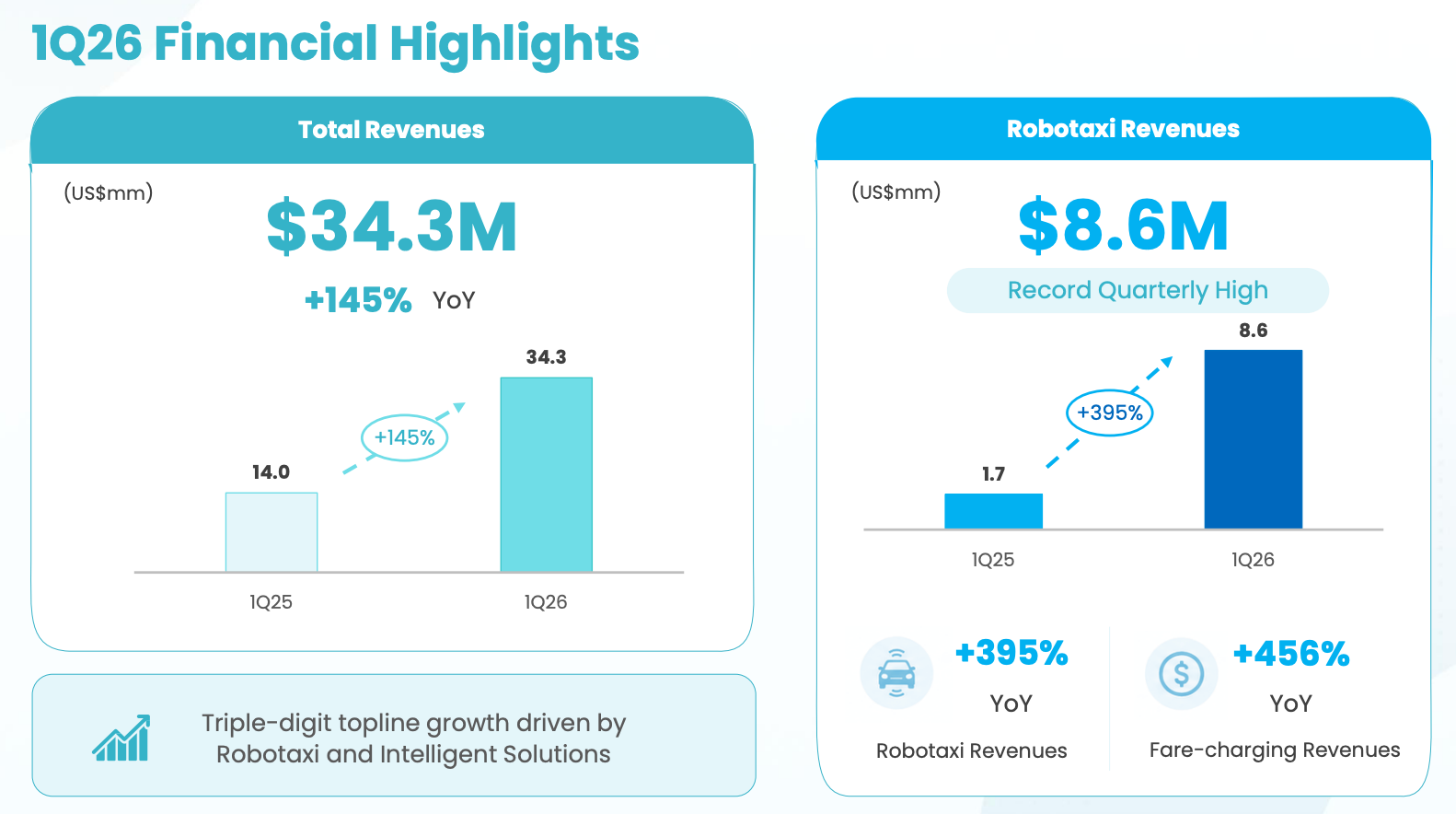
Pony.ai opened 2026 with a strong quarter, and management used it to raise the bar for the year. Total revenue reached a record $34.3 million, up 145% from $14.0 million in Q1 2025. The mix is where the story lives.
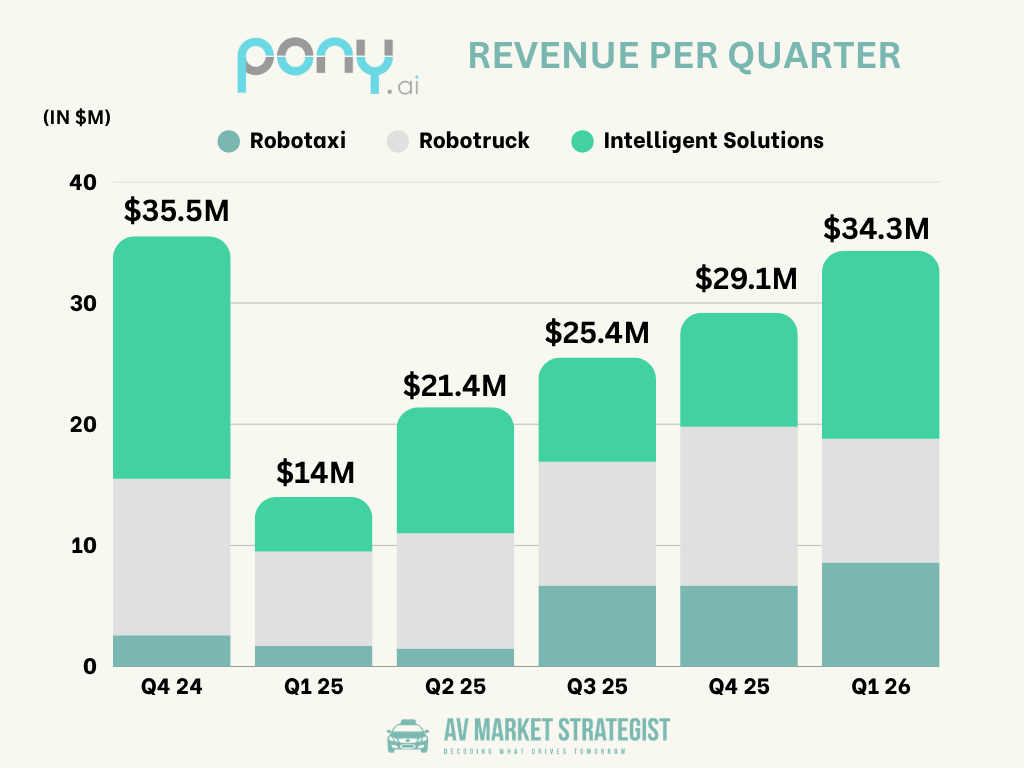
Robotaxi revenue, the core engine, hit $8.6 million, up 395% from $1.7 million a year ago, with fare-charging revenue up 456%, an over five-fold jump that CEO James Peng credited to the Gen-7 fleet and the new joint-deployment model. The operating metrics back it up. Registered users in China more than tripled year over year, and average weekly paid orders in May ran 119% above January. Management stressed that this acceleration came during spring, which Peng called a low season for ride-hailing, so the month-over-month growth is a genuine demand signal rather than seasonal noise.
Source: Pony AI Investor Presentation Q1/2026
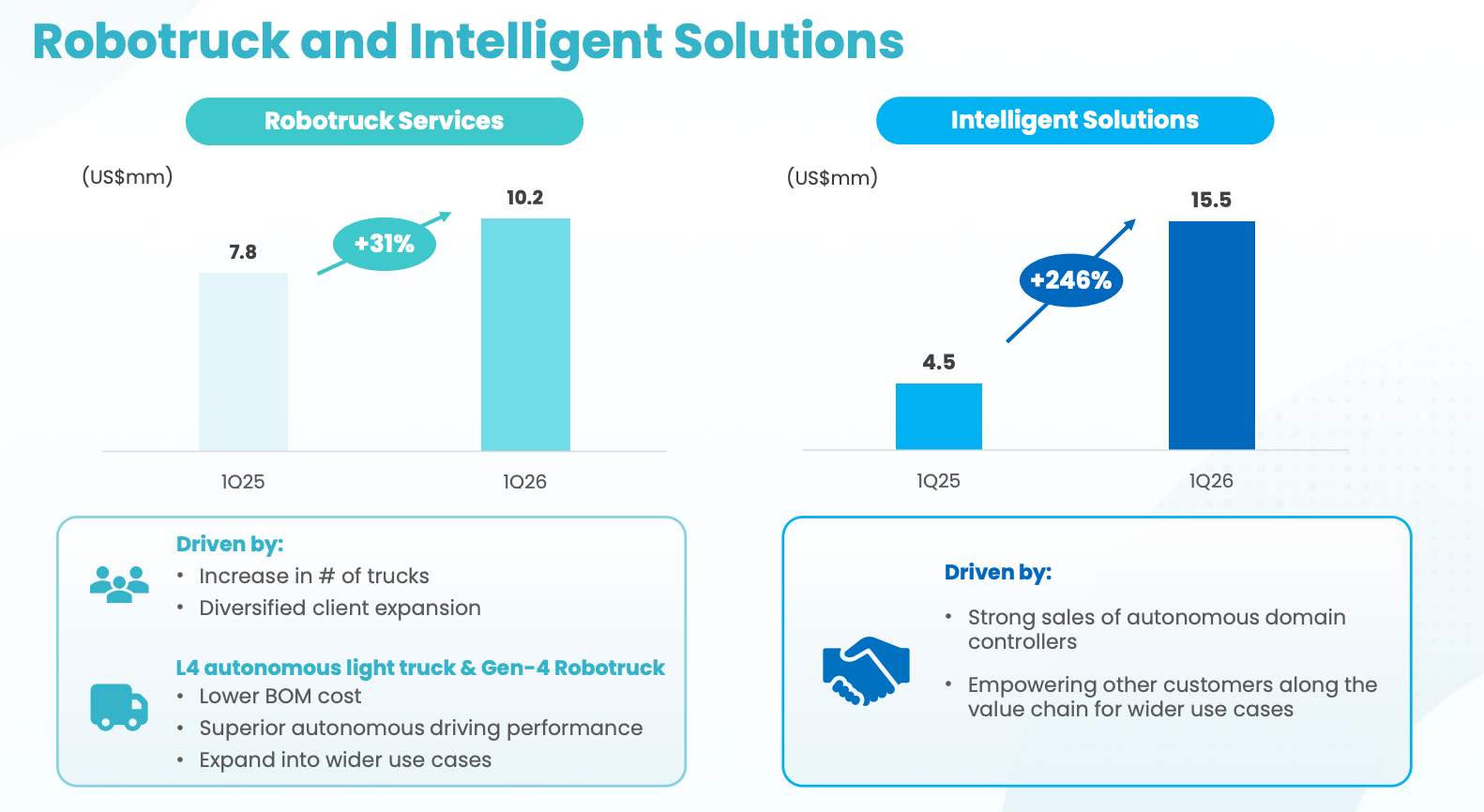
Robotruck revenue grew 31% to $10.2 million on scaled long-haul operations and a deepened tie-up with Sinotrans. The standout on a percentage basis was the segment Pony.ai just renamed from “Licensing and Applications” to “Intelligent Solutions,” up 246% to $15.5 million, driven by autonomous domain controller shipments that rose over five-fold across low-speed delivery, robosweeper, logistics, and humanoid robotics.
Source: Pony AI Investor Presentation Q1/2026
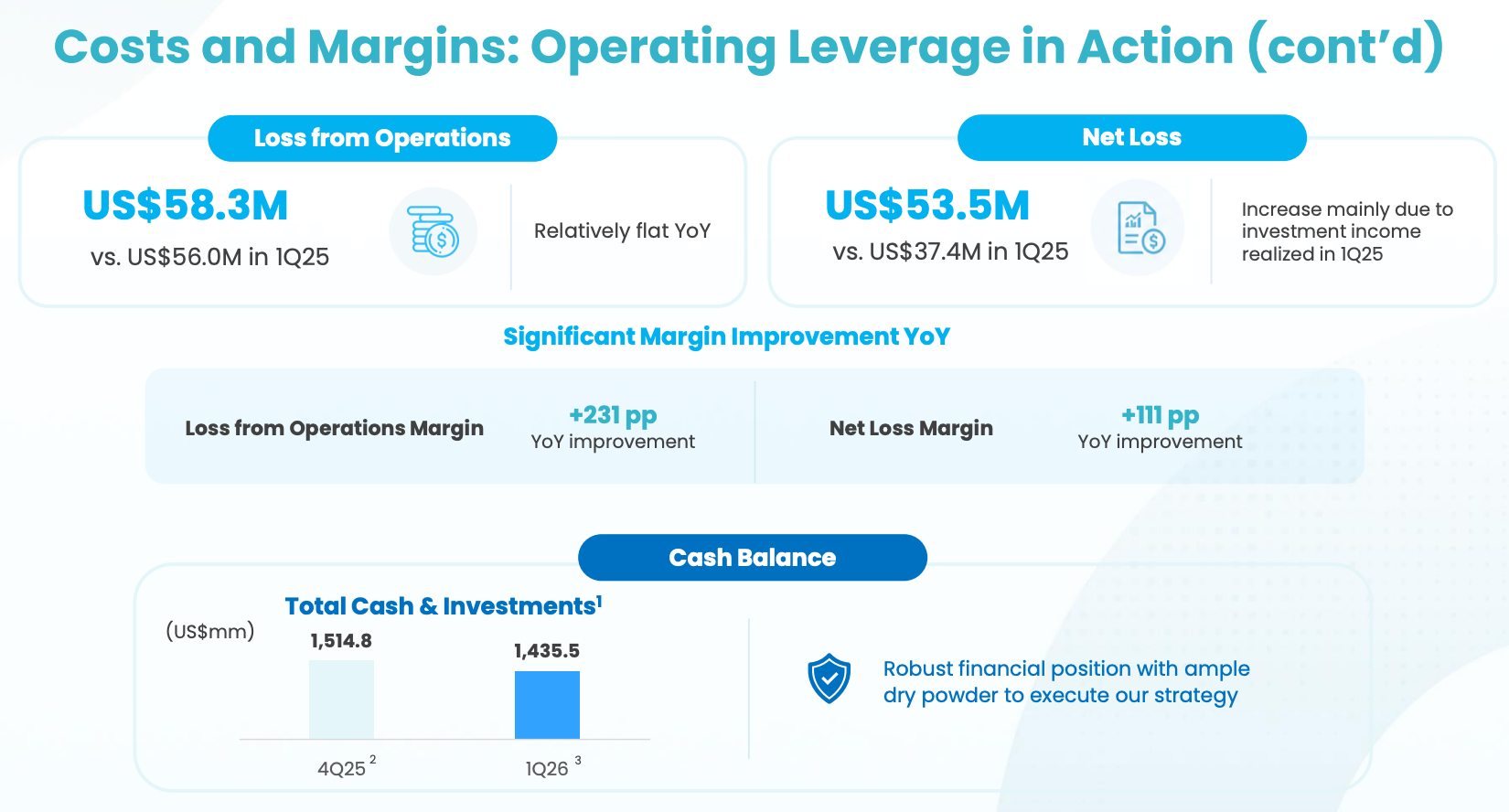
Gross margin was 16.2%, essentially flat against 16.6% a year ago, so the revenue surge is not yet improving the margin structure. Operating expenses rose 9.5% to $63.9 million, with R&D roughly flat at $47.9 million and SG&A up 47% on global compliance and expansion costs. Loss from operations was $58.3 million, broadly flat against $56.0 million. Net loss widened to $53.5 million from $37.4 million, though management attributes most of that to lower investment income against a high prior-year base, not operating deterioration. The cleaner signal is operating leverage: loss-from-operations margin narrowed sharply from negative 401% to negative 170%, and net loss margin from negative 268% to negative 156%. The losses are still huge relative to revenue. The direction is what management wants you to see.
The balance sheet gives them room. Cash and equivalents, short-term investments, restricted cash, and long-term wealth-management instruments stood at $1.44 billion as of March 31, down from $1.51 billion at year-end, with capex up to $12.5 million from $4.9 million on Gen-7 production and ADK stock-building. The burn is real and rose this quarter, but the runway is multi-year.
Source: Pony AI Investor Presentation Q1/2026
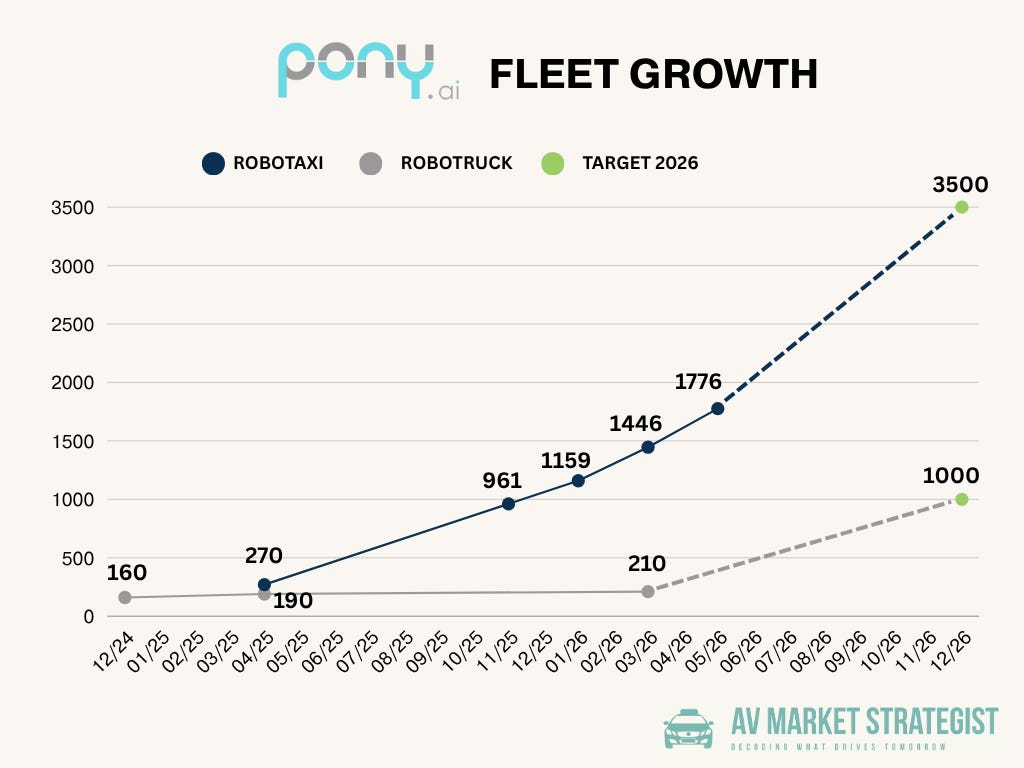
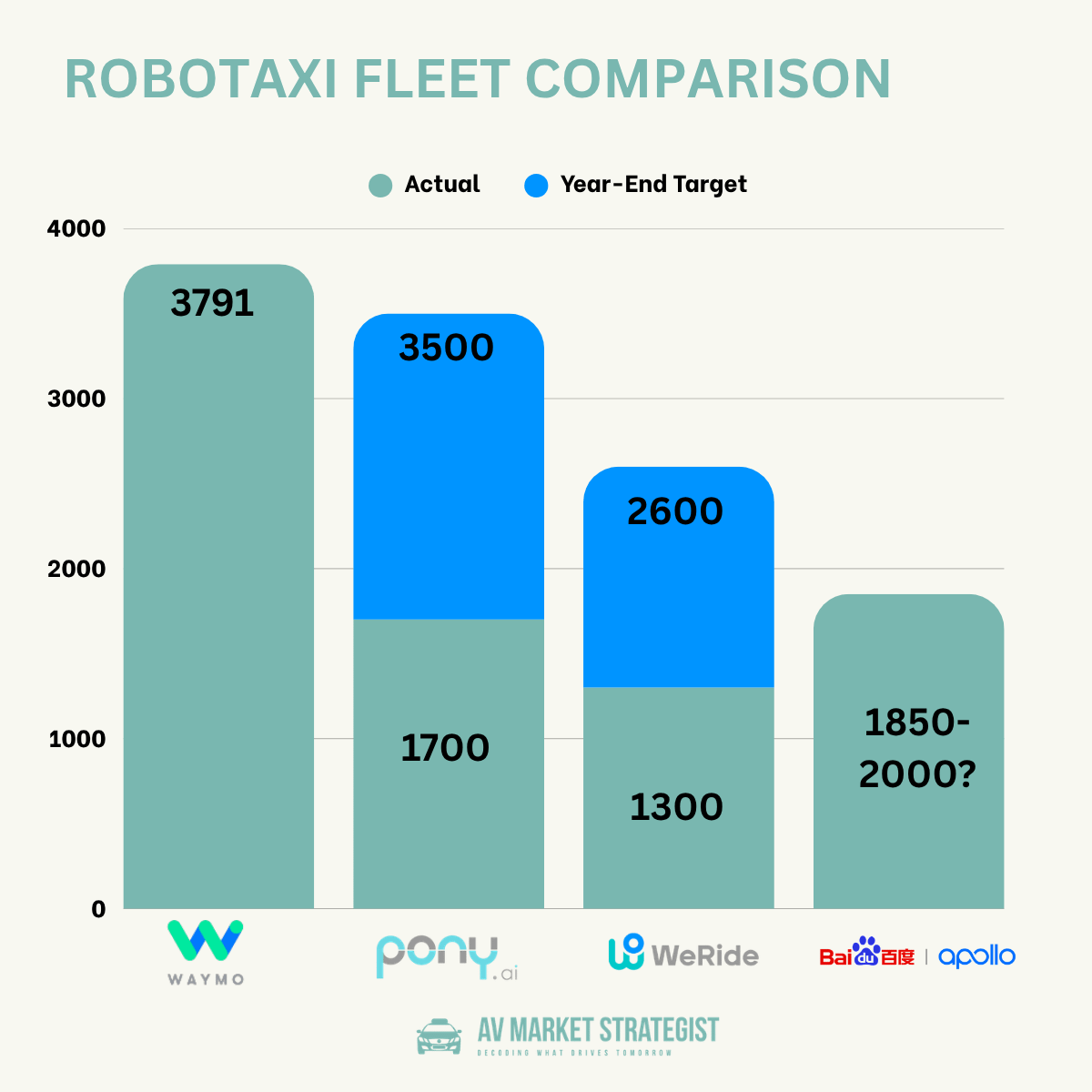
The fleet and guidance are the headline. Pony.ai has scaled past 1,700 robotaxis (1,776 produced as of May 26), rolling out Gen-7 across BAIC, GAC, and Toyota. On the strength of Q1, management raised both targets: year-end fleet from 3,000 to more than 3,500 vehicles, and robotaxi revenue growth from 3x to more than 3.5x of 2025, across 20-plus cities. The cost path was reaffirmed too: a 2027 robotaxi BOM, including the autonomous kit and base vehicle, below 230,000 yuan, cheaper than a base Tesla Model 3.
The joint-deployment model started generating revenue this quarter and lets Pony.ai put more vehicles on the road with less of its own capital. Internationally, Pony.ai now has a presence in 9 countries and public service in 4 overseas markets: Croatia, Qatar, Singapore, and South Korea.
A quick scale check against the peers I track. Pony.ai’s 1,700-plus robotaxis, up from the roughly 1,446 units I reported in CW13. Pony is still ahead of WeRide, which last disclosed about 1,300 robotaxis inside a total fleet of 2,800 autonomous vehicles. Both Chinese players still sit below Waymo, which runs 3,791 vehicles, as we learned from the NHTSA recall.
WeRide returns to Roland-Garros, for the third year
WeRide is back at the French Open. For the third consecutive year, its autonomous Robobus is running the only autonomous public shuttle service at Roland-Garros, in partnership with Renault Group, with beti operating the vehicle on the ground. The route is 2.8 kilometers with a 12-minute journey connecting three stops through the stadium complex, running May 24 to June 7, including a second year of night service.
On its own, a tennis shuttle is a marketing milestone, not a scaling one. The strategic value is what it sits on top of. WeRide now has active European deployments across France, Belgium, Switzerland, and Slovakia, plus Spain’s first public-road L4 passenger trial in Barcelona. This is the same company that last week removed the front-row safety driver from its Robobus at Zurich Airport and is preparing driverless Robotaxi service in Furttal, Switzerland. Europe is quietly becoming WeRide’s second home market. A high-visibility event like Roland-Garros, run reliably for three years, compounds the regulatory familiarity and brand trust that I have called WeRide’s European process-power advantage.
BYD builds its own 4nm smart-driving chip
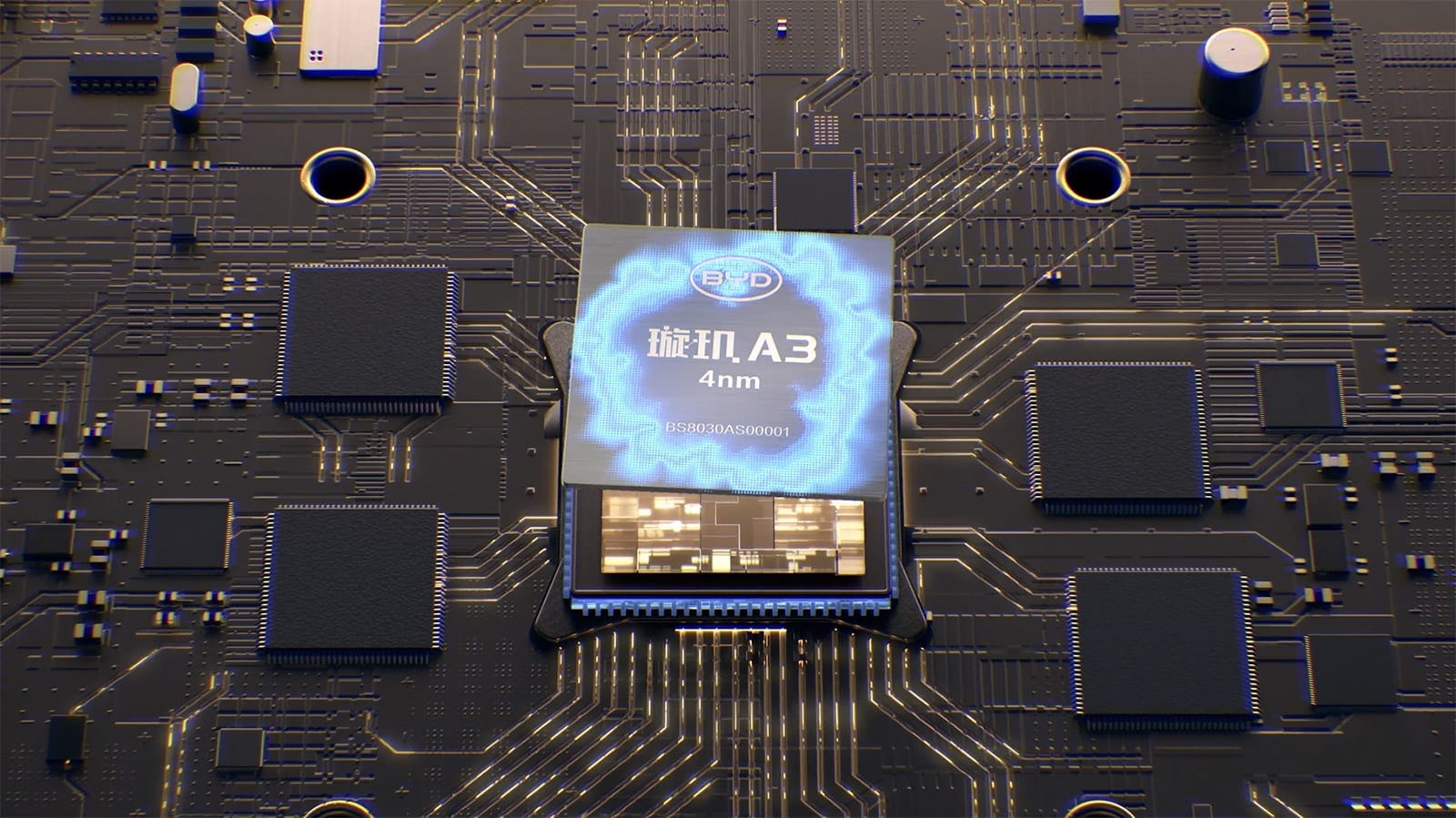
BYD unveiled its in-house Xuanji A3, which it calls China’s first 4nm smart-driving chip, supporting L3 and L4 functions and already in large-scale mass production.
Source: CNEVPost
A three-chip cluster delivers over 2,100 TOPS, and BYD says in-house algorithm optimization doubled the chip’s compute-utilization rate. The company has put more than 100 billion yuan, about $14.75 billion, into semiconductor R&D, runs a chip team of over 7,000 people, operates five wafer fabs, and claims to be the only automaker globally with full-process chip manufacturing across all seven core steps.
There is more to the launch than a spec sheet. BYD frames the Xuanji A3 as the most powerful self-driving chip to come out of China and claims best-in-class energy efficiency, drawing roughly 20% less power than comparable parts. That number matters more than it sounds, because heat and battery drain are hard limits on how much compute a moving car can actually carry, a point Augustin Friedel made on my Autonomy Insiders podcast when he flagged thermal performance as an underrated chip criterion.
The commercial play is volume, and it is aggressive. BYD will push its LiDAR-based driver assist, branded God’s Eye, down into mass-market cars, including the Seagull hatchback that starts around 69,800 yuan, roughly $10,300, offering the upgrade as a 12,000-yuan option that Wang Chuanfu says is priced “only at cost.” Sensor hardware automakers normally reserve for luxury models is becoming a checkbox on the cheapest EVs. This is the volume game in its purest form, and it is exactly the dynamic Friedel described on the podcast: in-house silicon only pays off at scale, which is why Chinese players spread their chips across every model and into adjacent verticals like humanoid robots and air taxis to manufacture the volume that makes the economics work. BYD already has the scale most rivals can only target. It says more than 3.15 million of its vehicles now carry advanced driver-assist hardware, generating around 200 million kilometers of real-world driving data every day, a feedback loop that trains the next software release.
The boldest signal is on liability. BYD said it will take full financial responsibility for accidents caused by its urban navigate-on-autopilot system, the God’s Eye A and B versions, for one year from delivery, extended to existing owners after a software update. Accepting what is effectively L3-grade liability while the system is still legally L2 is meant to broadcast confidence. Read it with care, though. God’s Eye has drawn a steady stream of owner complaints that it underdelivers on its promises, and analysts rightly warn that fleet scale is not the same thing as system maturity. A liability guarantee is a clever way to turn a safety question into a marketing weapon and force rivals to match it. It is a promise backed by an insurance policy, not yet a safety record.
This is the vertical-integration endgame, and it connects directly to last week’s analysis. The Aicha Evans thesis from CW21 was that Chinese AV players inherit a hardware-software-systems mindset from the electronics era, and BYD, which started as a phone-battery supplier, is the cleanest example. Owning the silicon lets BYD integrate hardware and software at a level that buying merchant chips from Nvidia or Qualcomm does not allow. It also follows a pattern: Nio’s Shenji NX9031, XPeng’s Turing, and Li Auto’s Mach M100 are all in-house chips now shipping.
My take
China this week scaled all three things at once: cost, revenue, and geography. BYD is driving the cost and integration curve with its own silicon. Pony.ai is converting fleet scale into 145% revenue growth and raised guidance, even if company profit stays distant. WeRide is extending its geographic lead in Europe one high-visibility deployment at a time.
The connective point is that these are not three separate stories. They are the same flywheel. Cheaper Chinese silicon and vehicle platforms lower the BOM. Lower BOM plus proven unit economics in Guangzhou and Shenzhen make overseas expansion fundable without waiting for company-level profit. And early, reliable overseas deployments lock in the regulator relationships that compound into process power. The squeeze at home, a saturated ride-hailing market and stock prices punishing the profit gap, is exactly what pushes these players abroad faster than their Western peers.
Strip away the company-by-company detail and the spine of the week is Chinese hardware. It builds the cheapest robotaxi bodies, including the Zeekr that became Waymo’s own Ojai. It is pushing sensors and now in-house silicon down the cost curve, with BYD’s Xuanji A3 the latest proof. And it is what lets Pony and WeRide fund overseas expansion years before they turn a company profit. Here is the uncomfortable part for the West.
Waymo, the only US-domiciled robotaxi operator genuinely scaling, has exactly two peers growing at the same pace on deployment, and both, WeRide and Pony, are Chinese, with Baidu just behind. The US leader’s sharpest competitors are Chinese, and the US leader’s own answer to its cost problem was to buy a Chinese-built car. That is the structural fact of the 2026 AV market: the race is being decided less by who has the smartest driving model and more by who controls the hardware cost curve, and right now that curve runs through China. Every Western player is exposed to it, whether through a supply chain, a shareholder, or a competitor, and the policy fight in Washington is, at bottom, an attempt to legislate away a dependency the industry has already built.
🔗 Pony.ai / Pony.ai (2) / WeRide IR / CnEVPost / CNEVPost (2) / Bloomberg / Q1/2026 Earnings Call Transcript
💡 Quick Takes
Revel and Voltera merge to build robotaxi charging at scale
Private-equity-backed Voltera and Revel Transit have agreed to merge their EV-charging businesses to serve ride-hail cars and robotaxis across US cities. The combined company, operating under the Voltera brand and led by Revel CEO Frank Reig, is expected to run more than 1,000 charging stalls across 11 major US markets. EQT becomes majority owner, with Revel backer BlackRock’s Global Infrastructure Partners keeping a stake. The deal lands nine months after Revel wound down its money-losing New York rideshare arm to focus on charging, with Uber guaranteeing driver usage at its station
Wayve launches an AI lab to look past self-driving cars
Wayve is standing up a research unit, Wayve Labs, led by chief scientist Jamie Shotton, a former Microsoft executive, to focus on embodied intelligence: AI that understands and acts in the physical world beyond driving. Dozens of employees already work there, with plans to recruit more and publish, and no immediate plans to commercialize.
Zeron raises $200M to scale autonomous heavy trucks
Chinese electric heavy-truck startup Zeron closed a $200 million Series B2, with Zijin Mining, Yankuang Capital, and Sanhua joining alongside international investors Temasek and InnoVen Capital. Combined with a 1.2 billion yuan round in March, the company has raised about $400 million in two months. Zeron, founded in 2022 by former TuSimple co-founder Huang Zehua, focuses on mining and industrial logistics, turned operating cash flow positive in Q4 2025, and says sales in the first four months of 2026 hit five times the prior-year level.
🔗 CnEVPost
ARLYX brings full autonomy to underground mining
Canadian startup ARLYX Technologies unveiled what it calls the first complete, fully electric autonomous solution purpose-built for underground material handling, developed over two years in Quebec and tested at a Tier 1 mine. Its utility vehicle and AutoLatch module transport, load, and unload up to 5,000 kg remotely, including during blasting periods when crews are evacuated, which ARLYX claims can add one ore load per day worth up to C$27 million annually per mine. A single teleoperator can oversee up to ten vehicles.
An autonomous bus is hit by a tram in Gothenburg
A Karsan e-ATAK autonomous electric bus was struck from behind by a tram in Gothenburg, Sweden, on May 25, about an hour into paid service on a year-long trial. No injuries. The trial runs with a safety driver onboard, and Vasttrafik said “the bus braked and was hit by the tram.” Karsan says preliminary evaluation indicates the autonomous system “functioned as designed” and the tram failed to keep sufficient following distance, framing it as an ordinary traffic incident rather than an AV failure, with the circumstances still under investigation. The e-ATAK, built with Adastec, is the only Level-4 bus on the European market and already runs in Norway, Finland, and beyond.
Torc joins Mila to deepen physical-AI research
Torc Robotics formed a strategic partnership with Mila, the Quebec AI institute founded around Yoshua Bengio, becoming the only autonomous trucking company embedded in the institute. Torc gets on-site research space and access to talent, building on an affiliation dating to 2020, to work on generative world models, multi-agent behavior, reinforcement learning, and foundation models for physical AI.
🔗 Torc
Einride brings in TÜV SÜD to verify its safety governance
Einride partnered with TÜV SÜD for an independent assessment of its Safety Management System, the organizational layer governing how it maintains its safety case and evaluates changes to its technology. The pitch is moving beyond one-off audits to a verified governance model, so Einride can show regulators in every market that its method for proving a change is safe has itself been independently checked. Its stack uses a hybrid of machine-learning navigation plus a deterministic safety checker, aligned to UL 4600, ISO 26262, and ISO 21448.
🔗 Einride
Port of Antwerp-Bruges picks four players to test autonomous trucks
Europe’s second-largest port appointed four manufacturers to make autonomous trucks available to companies for real-world testing, including container transport on public roads.
🔗 Flows
🎧 Autonomy Insiders
In Episode 12 of Autonomy Insiders, I sat down with Crijn Bouman, CEO and co-founder of Rocsys, the Dutch company building autonomous robotic charging systems for robotaxi and heavy-duty fleets.
Crijn explains why charging, sets the rhythm of every depot, why all robotaxi fleets eventually become mixed fleets, and why that logic drove the M1, the world's first multi-bay hands-free charger.
📚 Worth Reading/Listening
Harry Campbell: Inside Uber’s AV Strategy with Founding Member Eduardo Rojas
🔗 The Driverless Digest
📊 Weekly Performance
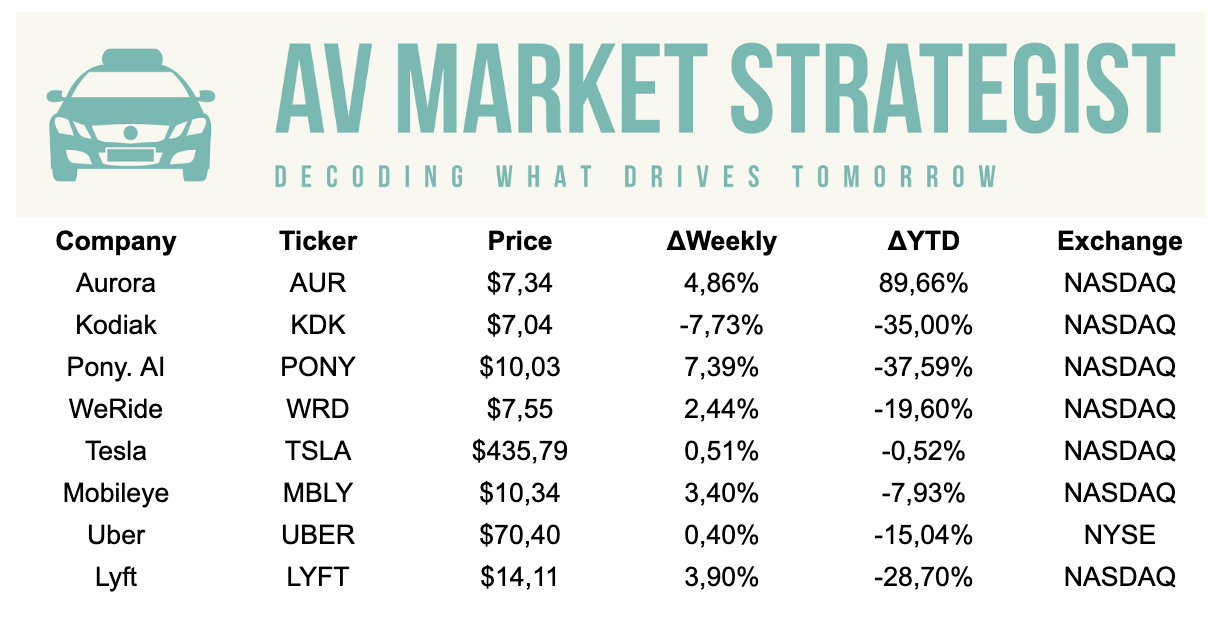
Note: Stock performance data as of May 31st, 2026. Past performance does not indicate future returns.
Thanks for reading!
If you found value in this newsletter, please consider sharing it with a friend or colleague who might benefit from these insights.
And if you haven’t already, subscribe to stay updated on the latest developments in the autonomous driving industry.
Disclaimer: This newsletter is provided for general informational and educational purposes only and is subject to change without notice. While we obtain information from sources we believe to be reliable, we do not guarantee its accuracy, completeness, or timeliness. We accept no responsibility for any actions taken based on this newsletter or for any losses resulting from its use. Nothing in this newsletter constitutes, or is intended to constitute, financial, investment, trading, legal, accounting, or tax advice. The content does not take into account your individual objectives, financial situation, or needs and must not be relied upon as personalized recommendations to buy, sell, or hold any security or other financial instrument. You should always do your own research and consult a licensed financial professional before making any investment decisions. Any opinions or views expressed in this newsletter are those of the authors at the time of publication and may change without notice. They do not necessarily reflect the opinions of any affiliated entities.
Waymo built the best robotaxi in the US on a Chinese body and that is the actual story.
"Tesla shrinking" 😬