
👋 Welcome back everyone,
This week was a mixed bag for Waymo. Coverage grew 27% to 1,400 square miles, but new CPUC data shows California growth slowing, a software recall covers nearly 4,000 vehicles, and a London petition is trying to halt the trial. Meanwhile, Nuro picked Germany as its first European base. Tesla quietly unredacted every Robotaxi crash narrative on file. And WeRide opened the year with a 58% revenue jump YoY.
Let’s dive in!
⏱️ ~5300 words, 24 minute read

This newsletter is brought to you by Rocsys.
The 1st multibay hands-free charging solution for robotaxis is here!
Rocsys announces the M1, the world’s first hands-free charging solution for robotaxi fleets, purpose-built for multibay operations.
This overhead rail-mounted system integrates with virtually any depot layout and can charge multiple vehicles across up to 10 bays, supporting safe, uninterrupted service. The Rocsys M1 delivers consistent, predictable performance and up to 75% higher operational efficiency with existing staff, helping fleets get vehicles back on the road faster.
Compatible with any charger and vehicle type across mixed fleets, the M1 enables higher vehicle uptime while improving the bottom line.
Waymo grows, slows, recalls, and gets a London petition. Tesla finally shows the crash data.
Let’s start with Waymo.
Waymo coverage hits 1,400 sq mi across 11 cities
Waymo announced its service area is now over 1,400 square miles across 11 US cities. That is a 27% jump from the roughly 1,100 square miles estimated at the start of April. The expansion is starting in Miami, with Austin, Atlanta, Houston, and the SF Bay Area next.
This growth helps Waymo be “match-ready” as several of the cities Waymo serves prepare for the FIFA World Cup. Waymo will be available in six U.S. host cities, providing residents and millions of international fans with an AV to navigate the festivities.
The interesting detail is that none of these are new cities. Waymo is growing inside its existing footprint, not only planting flags. Before this expansion, the operating areas were roughly:
Phoenix at ~315 sq mi
SF Bay Area at ~260 sq mi
LA at ~120 sq mi
Austin at ~90-130 sq mi
Atlanta at ~60 sq mi
Miami at ~60 sq mi
Orlando at ~60sq mi
San Antonio at ~60 sq mi
Dallas at ~50 sq mi
Houston at ~25 sq mi.
The roughly 300 sq mi added in a single wave is the biggest operating area push so far.
Waymo’s flooding recall
On May 12, NHTSA published a software recall covering 3,791 Waymo vehicles. The failure mode behind the recall is that the autonomy stack was correctly identifying flooded roadways and reducing speed, but it was not consistently coming to a full stop before entering water that the vehicle could not cross. In central Texas this turned into a serious incident, with an empty robotaxi getting swept into a creek in San Antonio. Operations in that city have been paused.
Both the 5th-generation and the 6th-generation Waymo Driver are inside the recall scope. The initial fix is a software update that places restrictions in higher-speed areas where flooding risk is elevated. Per Waymo’s own statement, the company is still “implementing additional software safeguards” and “refining extreme weather operations during periods of intense rain.” NHTSA notes that a “final remedy” is still being developed. So this is not a closed recall.
A number that is interesting and matters for the strategic picture is 3,791. Waymo's own marketing has consistently said "roughly 3,000 robotaxis." The NHTSA filing implies the operational fleet plus reserves, mapping vehicles etc., totals closer to 3,800.
California growth is flattening
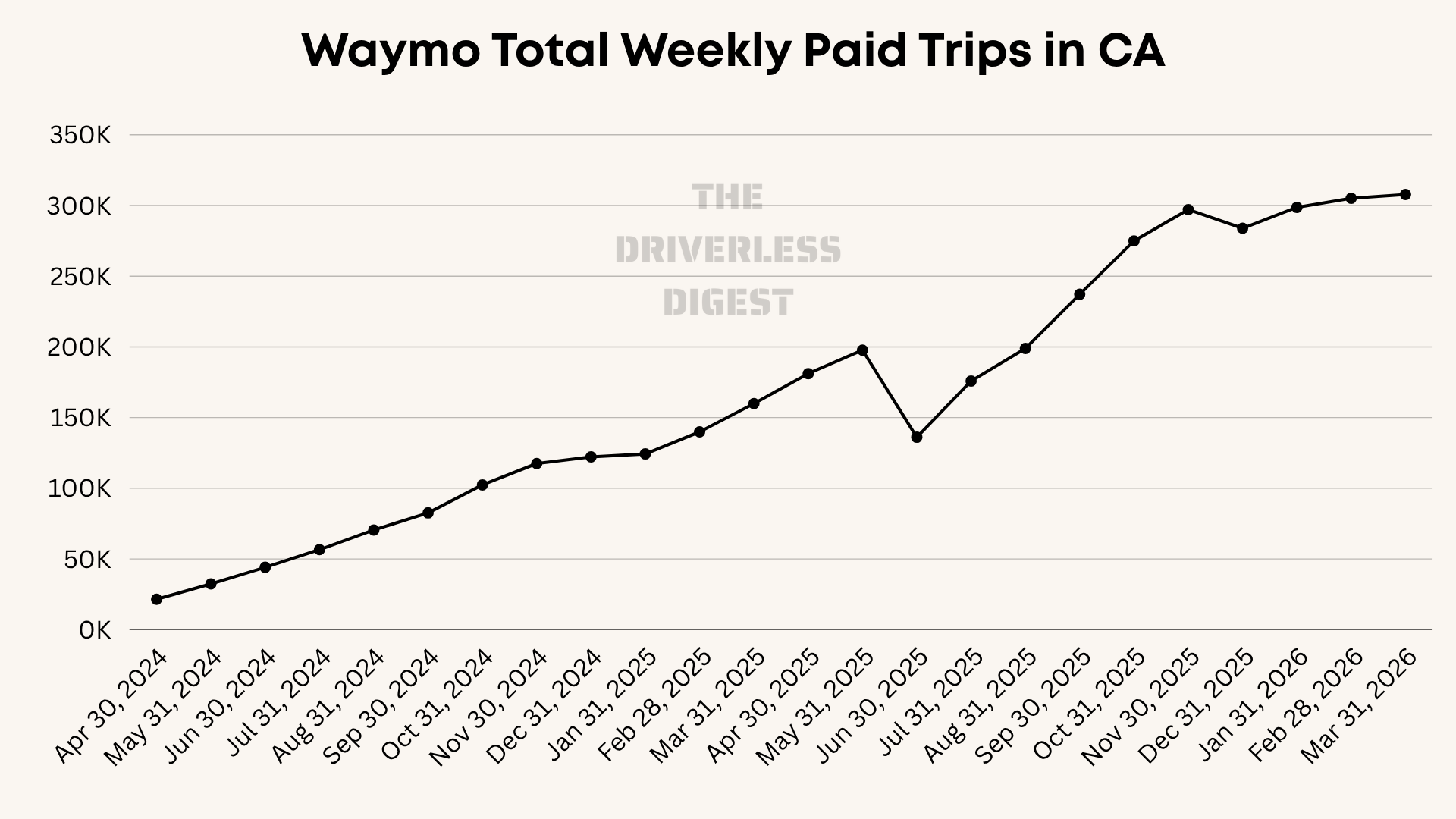
While Waymo expands its service area, the CPUC data tells a more nuanced story about its most mature market. Harry Campbell pulled the new Q1/2026 figures in The Driverless Digest.
Source: The Driverless Digest
Monthly incremental rides per week in California:
January: +14,800
February: +6,400
March: +2,700
That is an 82% deceleration in the pace of growth from January to March. Total California rides are still rising, but the rate of growth has fallen off a cliff. Outside California, the picture is the opposite.
There is no single explanation for the California slowdown, but some are worth considering.
Waymo has captured a lot of California rideshare, and the next user cohort is maybe more price- and time-sensitive than the early adopters. It could also be fleet constraints. If 3,791 robotaxis are spread across 11 cities, every new market launch pulls capacity out of Phoenix, SF, and LA.
A deliberate strategic shift could also be possible. Waymo could be deprioritizing California ride volume in favor of geographic breadth. But this argument runs against the news that Waymo expanded the service area in existing cities significantly this week.
The reading I would default to is mostly fleet constraints, plus some demand softening at the margin. But that’s just my guess.
London: the political backlash starts
While Waymo manages its US operational load, London is becoming the political headache.
On May 12, the Brent Green Party launched a petition asking the Mayor of London to pause Waymo’s London robotaxi testing programme. The triggering incident happened on Harlesden High Street on April 22, when a Waymo test vehicle entered an active Metropolitan Police crime scene. Officers were on site working a double-stabbing investigation when the vehicle crossed the cordon tape.
Waymo’s response is worth quoting in full, because it matters analytically: the vehicle “was operating in manual mode with a validation driver in full control.” The driver has been suspended.
This is where I want to push back on the framing the Green Party is using. If a Waymo employee in manual mode drove through a police cordon, the relevant question is about driver hiring and training standards. It is not a question about whether the autonomy is ready. Calling for the trial to be paused on the back of a human-driver failure is, in my read, political theatre.
That said, Waymo has been picking up other London incidents that are autonomy-side, and they are not nothing. In Shoreditch, one of the test fleet repeatedly attempted to enter a gated dead-end street and got trapped. Waymo subsequently restricted the autonomous routing logic around that block. Residents on another street reported a Waymo car waking them at 4am after taking a dead-end route three times in one week. These are minor on their own, but they aggregate into the kind of friction that gives local politicians something to point at.
Nuro plants a flag in Germany
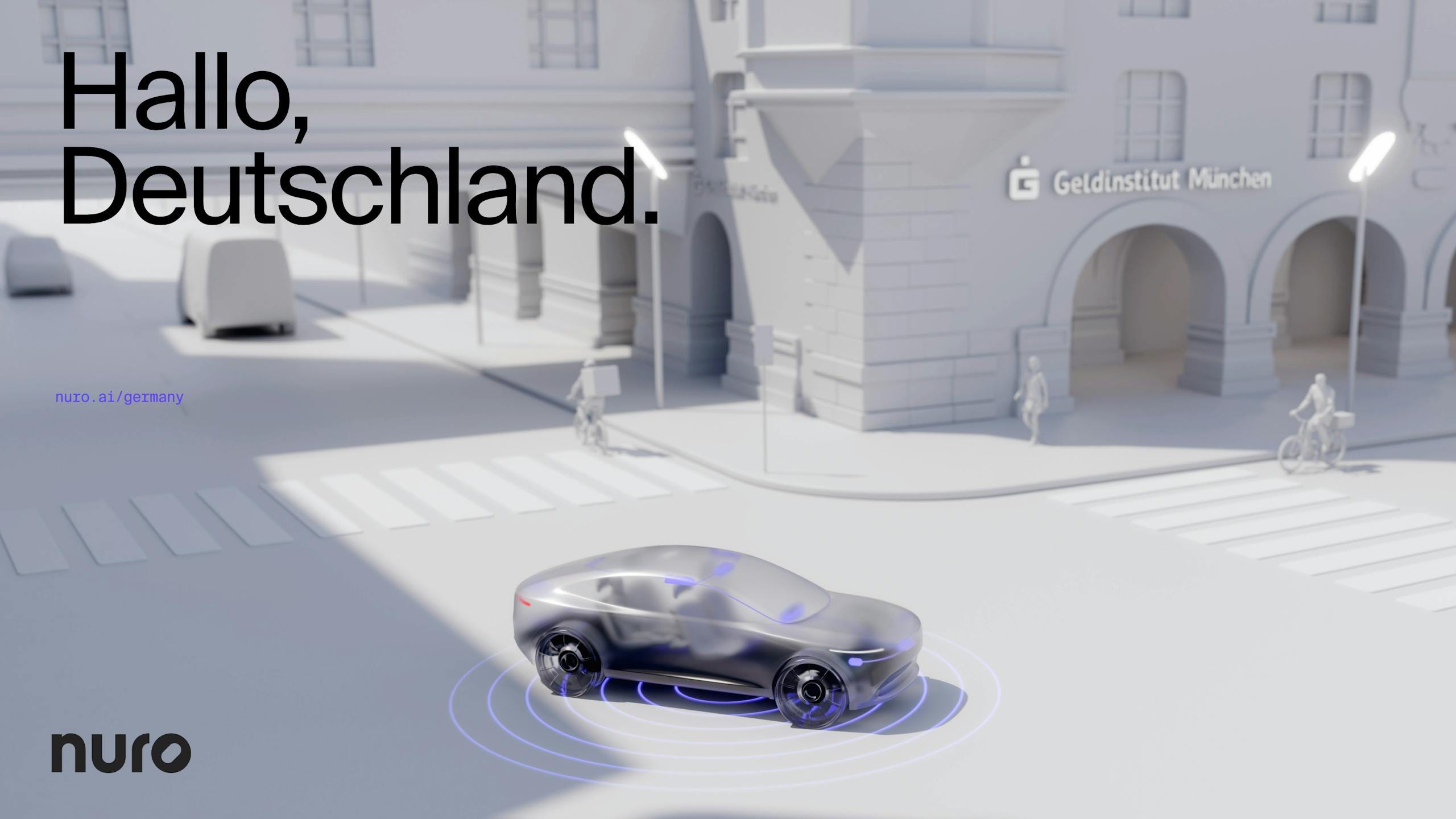
While US players manage their operational and political backlash, a different US player has just made its first move into Europe. Nuro announced it is opening a Munich-area office as its European hub. The office will support engineering, operations, and partner engagement.
Source: nuro
This is Nuro’s third country base after the US and Japan. Nuro is positioning its Nuro Driver as a Level 4 platform that scales across personally-owned vehicles, robotaxis, and logistics. The Japan demo this year was the public proof point: Nuro showed “zero-shot autonomy,” meaning the Driver operated in a new driving environment without prior training on local data.
The interesting detail is what Nuro did not say. The press release for the Munich announcement mentioned personally-owned autonomous vehicles, robotaxis, and logistics as the three target vehicle categories. It did not name Lucid as the German launch partner. Munich is BMW’s home market. BMW recently shut down its in-house Level 3 program and has no obvious Level 4 roadmap of its own. Nuro now offers a full L4 stack that is OEM-agnostic and that BMW could, in theory, slot into a personal-vehicle programme without rebuilding from scratch.
To be fair, the counter-read is also live. Lucid’s interim CEO Marc Winterhoff has publicly stated that the Uber-Lucid-Nuro robotaxi service is going beyond the US into European markets. So Munich could simply be the European base for that programme, with Lucid hardware. The two stories are not mutually exclusive. Nuro has no exclusivity to Lucid, and an OEM-agnostic Level 4 stack is exactly the kind of product that benefits from a second hardware partner with European volume.
For me, as a German, this is a good thing, and I love to see VD players coming to Germany. Whether Nuro can convert a Munich office into operational deployment is a 2027 question, but the bid is on the board.
Tesla finally unveils crash data
The Tesla story this week is the one that matters most for transparency. On May 15, Tesla refiled every one of its 17 NHTSA crash reports without the “confidential business information” redaction. Until this week, Tesla was the only ADS operator filing under NHTSA’s Standing General Order 2021-01 that completely redacted its crash narratives. Waymo, Zoox, Avride, May Mobility, and every other operator provided multi-paragraph descriptions.
A reminder of what we covered in CW17: Tesla even told NHTSA it would “suffer financial harm” if the crash data became public. That argument is now apparently no longer in play. The motivation for the reversal is not stated.
Here is what we now actually know.
The 17 incidents span July 2025 to March 2026, the full Austin Robotaxi window. Every incident involves a 2026 Model Y with the ADS engaged and a safety monitor present.
Injury breakdown: 13 property-damage-only, 2 with no injuries reported, 1 with a minor injury and no hospitalization, 1 with a minor injury and hospitalization.
The headline takeaway is that most of the crashes were not Tesla’s fault, similar to the Waymo pattern we covered in CW8. An SUV rear-ended the Tesla at a red light. A truck rear-ended the Tesla at a stop sign. A passenger car rear-ended the Tesla at a flashing yellow left-turn arrow. The pattern of human drivers rear-ending stopped robotaxis matches what we already see in Waymo’s NHTSA filings.
That said, there are two categories of incident that should not get washed away by the “rear-ended at a red light” narrative.
First, the teleoperator crashes. In July 2025, the ADS got stuck on a street. The safety monitor called Tesla’s remote assistance team. A teleoperator took over, drove up a curb, and hit a metal fence at 8 mph. That incident produced the only non-hospitalized minor injury. In January 2026, the ADS asked for navigation help. A teleoperator took over and drove into a construction barricade at 9 mph. So in two separate incidents, the system asked a human to take over, and the human crashed the car.
In a Markey letter cited by TechCrunch, Tesla itself confirmed that teleoperators are permitted to drive the vehicle up to 10 mph. The legal framing is that this is meant to "promptly move a vehicle that may be in a compromising position." The operational reality is that the teleoperator capability has now produced 2 of the 17 reportable crashes. That is a 12% contribution rate from a fallback designed to reduce incidents.
Second, the ADS spatial-awareness incidents. The car drove into a metal chain after an unprotected left turn into a parking lot in September. It clipped a dump trailer’s gooseneck hitch sticking into the street in October. It reversed into a wooden electrical pole in January. It hit a curb reversing into a parking space, also in January. Tesla has historically pushed back on the idea that the vision-only stack misses smaller or unusual obstacles. These four incidents are direct counter-evidence, particularly while reversing.
The most serious crash by injury severity was the Tesla creeping forward at 2 mph in a right-turn slip lane, yielding for cross traffic, and getting rear-ended by an SUV. The safety monitor later reported pain and sought medical evaluation. On paper, this is the other driver’s fault. In the broader debate about whether overly cautious robotaxi behaviour increases rear-end risk, this incident can be seen as another data point.
What this all means
Two strategic threads sit underneath this whole storyline.
The first is that Waymo’s framing as the unambiguous deployment leader is still correct, but it is starting to face a different kind of stress test in 2026. The flooding recall, the London petition, and the California growth flattening are all manageable in isolation. Together they describe a company that is now big enough to be the subject of normal regulatory and political friction, not the curious-novelty stage. That is the natural cost of scale. The Scale Economies advantage Waymo is building is real, and is exactly the kind of moat that creates this friction. I would rather be Waymo with these problems than any competitor without them.
The second is that Tesla unredacting the narratives is, on net, a strategic positive for Tesla, even though it cost the company a year of negative perception. The data actually supports the case that most Tesla Robotaxi crashes are not the ADS’s fault. The teleoperator and spatial-awareness incidents are real concerns, but they are concerns at the level of “this is a Level 4 program that is genuinely in the early phase,” not “this is a fraud.” The fact that Tesla operates roughly 38 unsupervised vehicles in Austin, Houston and Dallas (per Robotaxi tracker) against Waymo’s 3,791 still defines the gap. But the transparency move was overdue, and it is the right call.
The piece I will be watching closely is which vehicle platform Nuro actually rolls out with in Germany. If it is Lucid, this is a US-Europe extension of the SF Uber programme. If it is BMW (or another German OEM), this is a different story.
🔗 Electrek / Electrek (2) / TechCrunch / TechCrunch (2) / The Driverless Digest / Zag Daily / Nuro / Road to Autonomy
Enjoying the AV Market Strategist?
If you find value in these deep-dives and enjoy the updates on autonomy each week — you can support my work.
Your contribution helps me access better data sources, industry reports, and research tools to keep every issue sharper and more insightful.
The newsletter will always remain free to read, whether you choose to support or not — but every bit of backing helps me make it even better.
WeRide Q1 2026 Earnings Call Analysis
WeRide reported Q1 2026 earnings on May 13. The headline is a 58% revenue jump, but the more useful detail is in the operating data and the unit-economics framing the company shared.
The financials
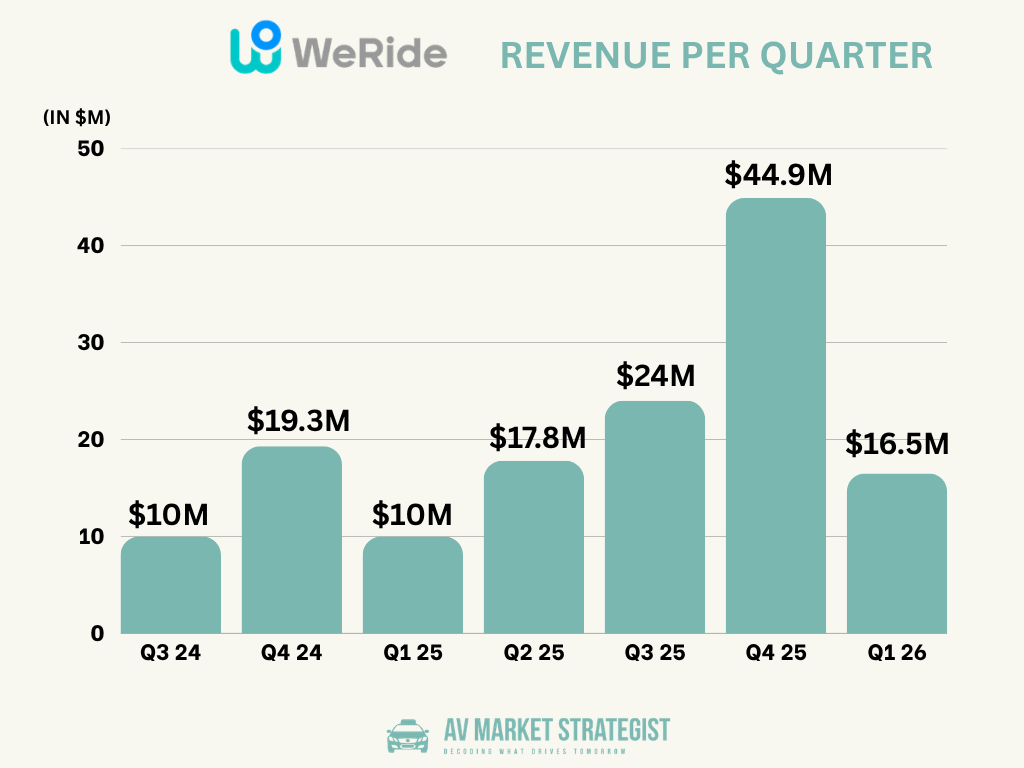
Total revenue came in at US$16.5 million in Q1, up 58% year over year. Product revenue grew 116% to US$3.0 million, driven by increased robotaxi and other L4 vehicle deployments. Service revenue grew 49% to US$13.5 million. The split tells us that product revenue, while still small in absolute terms, is the fastest-growing segment and is consistent with the asset-light overseas model where WeRide sells vehicles to partners and licenses software on top. Q4 2025 revenue was around $44.9M, so Q1 2026 at $16.5M is a meaningful step down quarter-over-quarter. This is probably due to seasonality with Chinese New Year domestically and Ramadan in the Middle East.
Gross profit was US$5.7 million, up 56%, with a group-level gross margin of 34.7%. CFO Jennifer Li flagged on the call that the gross margin held flat-to-up despite top-line expansion, and that the structurally stronger overseas margin profile is supporting this. As a reminder from CW18, WeRide has separately said overseas gross margins are roughly 50% versus 20-25% domestically. International revenue made up about one-third of total revenue last year, and management expects that share to keep rising in 2026.
Operating expenses came in at US$68.0 million, with R&D at 77% of OpEx (US$52.7 million, +12% YoY; +16% ex-SBC). Admin expenses dropped 33% to US$12.0 million, driven by lower professional services fees and audit/legal compliance costs after the dual listing settled in. Selling expenses were up 63% to US$3.3 million, in line with the overseas expansion.
Net loss was US$56.4 million IFRS, US$47.3 million non-IFRS (+11% YoY).
Cash position: US$902.4 million total, of which US$895.6 million is cash and time deposits. US$4.2 million is in investments in wealth management products, which were included in financial assets at FVTPL and financial assets at amortized costs, and US$2.6 million in restricted cash.
The $100 million share buyback authorized on March 23 is roughly 61% complete (24.4 million ADS repurchased for ~$61.4 million as of May 12). That is a signal of management’s confidence in the share price, and it consumes balance sheet that would otherwise extend operational runway, so it is a deliberate trade.
Fleet update
The fleet numbers are the second most useful data point this quarter. As of end of April:
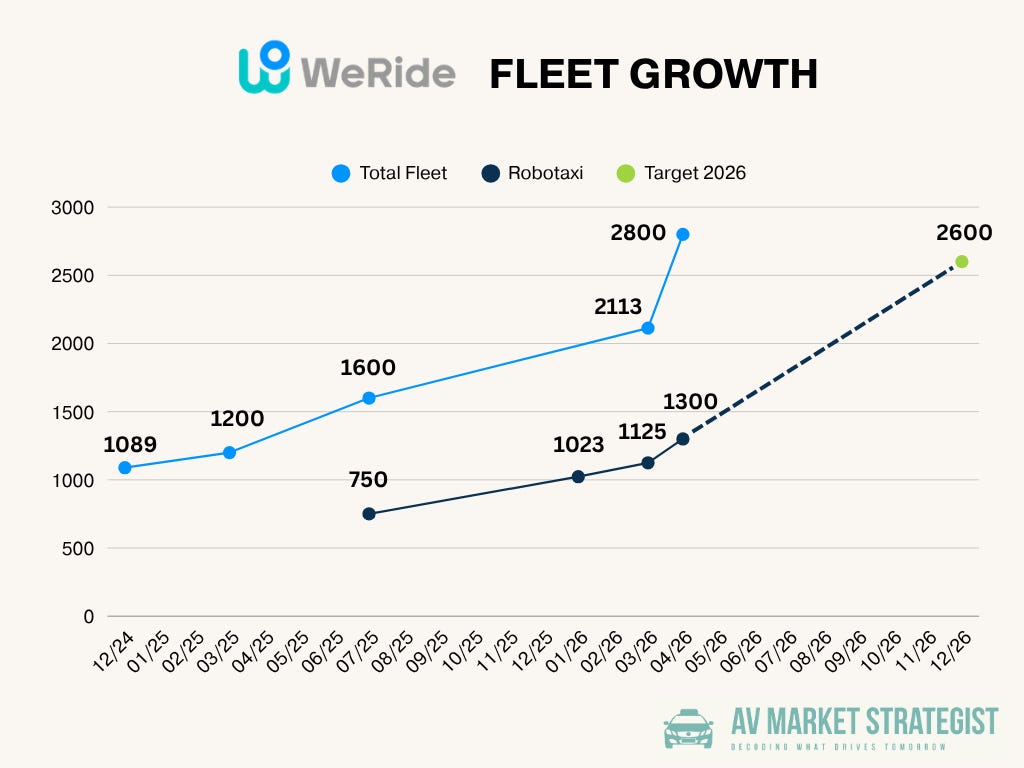
Global robotaxi fleet: ~1,300 vehicles (up from 1,125 in March)
Domestic robotaxi fleet: ~1,000 vehicles
Overseas robotaxi fleet: ~300 vehicles
Total L4 fleet (incl. robobus, robosweeper, robovan): ~2,800 units (up from 2,113 in March)
In Guangzhou, the service area grew 97% versus end of 2025. Average daily orders per vehicle in China hit 17 trips in Q1, with peak days at 28. Registered robotaxi users roughly doubled year over year.
Unit Economics
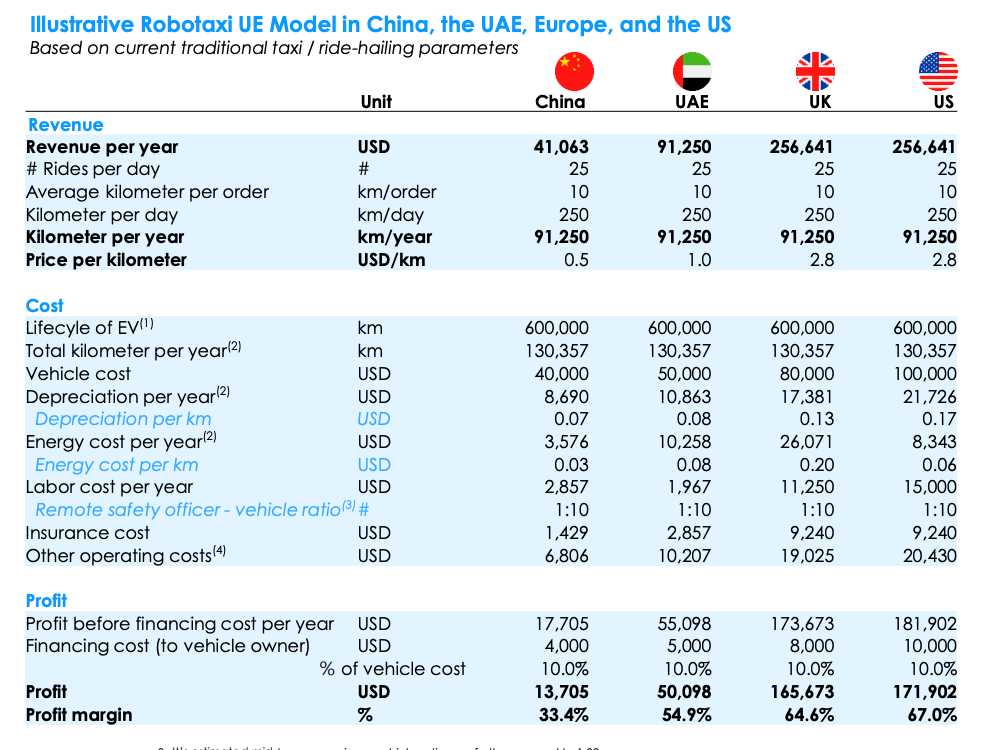
WeRide shared a four-country unit-economics view: China, the UAE, the UK, and the US. The framing is explicitly the perspective of a vehicle owner, which under the asset-light model is typically a third-party fleet partner, not WeRide itself.
Two caveats up front, because they matter.
First, this is labeled as an “illustrative” robotaxi UE model, “based on current traditional taxi / ride-hailing parameters.” The source line on the slide is “CIC, public info.” That is genuinely thin on attribution. We do not know which specific data points come from CIC, which come from “public info,” or which are WeRide’s own assumptions plugged into the model. The slide does not break out methodology by country.
Second, the assumptions are uniform across markets in a way that the real world is not. 25 rides per vehicle per day, 10 km per ride, 250 km per day, 600,000 km vehicle lifecycle, and a 1:10 remote safety officer ratio are applied identically to all four geographies. WeRide is using this as a directional comparison tool, not as a market-specific forecast.
So read the numbers as a directional argument, not as a forecast. With those caveats in place, the directional argument is still useful, because it was disclosed inside an earnings call and is therefore management’s own public framing of where the unit economics get attractive.
Source: WeRide Q1/2026 Investor Presentation
The directional takeaway is that the revenue side is where the gap between markets lives. China generates $41K of revenue per vehicle per year. The UK and US sit at $257K, more than 6x higher. The single biggest driver is price per km: China $0.50, UAE $1.00, UK and US $2.80.
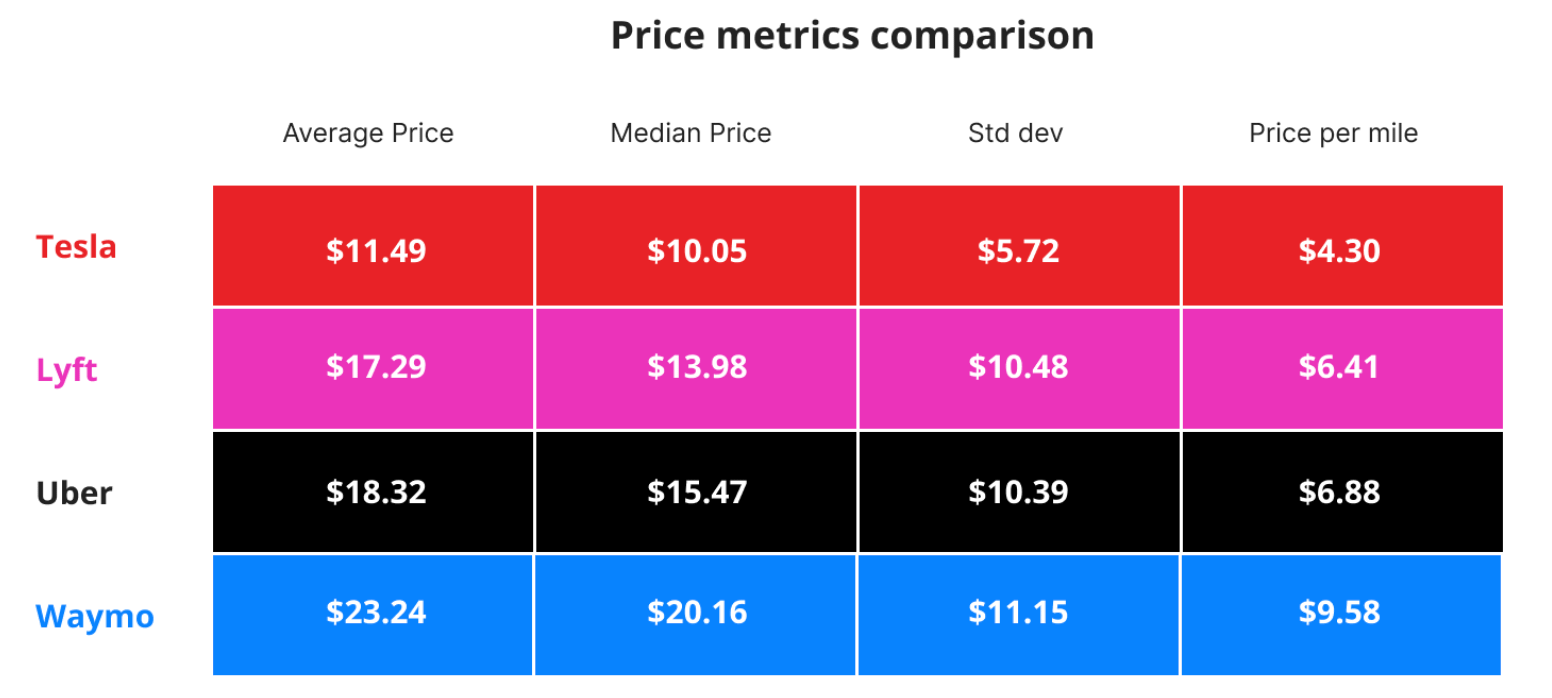
Looking at the current OBI Data from San Francisco, the $2.80 looks conservative.
Source: OBI
Converting the price per mile to price per km to make it a fair comparison, we get the following picture:
Tesla: 2,67 USD/km
Lyft: 3,98 USD/km
Uber: 4,28 USD/km
Waymo: 5,95 USD/km
On the cost side, China is meaningfully cheaper across nearly every line. Vehicles run $40K vs. $100K in the US. Labor runs $2,857/year vs. $15,000/year. Insurance runs $1,429 vs. $9,240. The cost savings are real, but they do not close the revenue gap. The model output: UK delivers $166K of annual profit per vehicle, the US delivers $172K, China delivers $14K.
Translated to margin: 33.4% in China, 54.9% in UAE, 64.6% in UK, 67.0% in US. If you take the model at face value, the international markets are 1.6x to 2x more profitable per vehicle as a margin business, and 12x more profitable in absolute dollars. That is the directional case for the overseas push.
A few specific points to highlight in the model.
The 25-rides-per-day assumption is on the upside of WeRide’s own operational reality. Actual Q1 China average was 17 rides per vehicle per day, with 28 at peak. So the model treats peak-day economics as steady-state for every market.
The 1:10 remote operator ratio is conservative for China specifically. WeRide stated on the call that the China ratio is now 1:40, four times better than the model assumes.
The "other operating cost" line bundles license, parking, maintenance, and grid operations. With no breakout, we cannot separate the cost.
Bottom line on the unit economics: this is management's directional argument for why overseas matters, not a forecast of any specific market's economics. The shape of the chart is more useful than the specific dollar amounts. The shape is: revenue side dominates, China is cost-cheaper but price-cheaper by more, international margins are structurally higher. That shape is consistent with what WeRide has been saying for the last quarters, and consistent with the gross-margin disclosures from earlier earnings calls. It is not new information for me. It is just better-illustrated information.
Asset-light direction, both abroad and at home
CFO Li confirmed that all overseas operations are running asset-light: WeRide either sells vehicles to operators or to third-party fleet owners. The company provides the autonomy stack and the operations capability, while partners carry the vehicle capex.
WeRide is now openly directing China toward the same model. Domestic priority is to keep improving the unit economics so the per-vehicle revenue share is “sizable enough” for third-party fleet owners to participate. That is the asset-light flywheel: prove the operating economics on your own balance sheet, then transfer the capex to partners as utilization rises.
Overview: WeRide’s global deployments and status
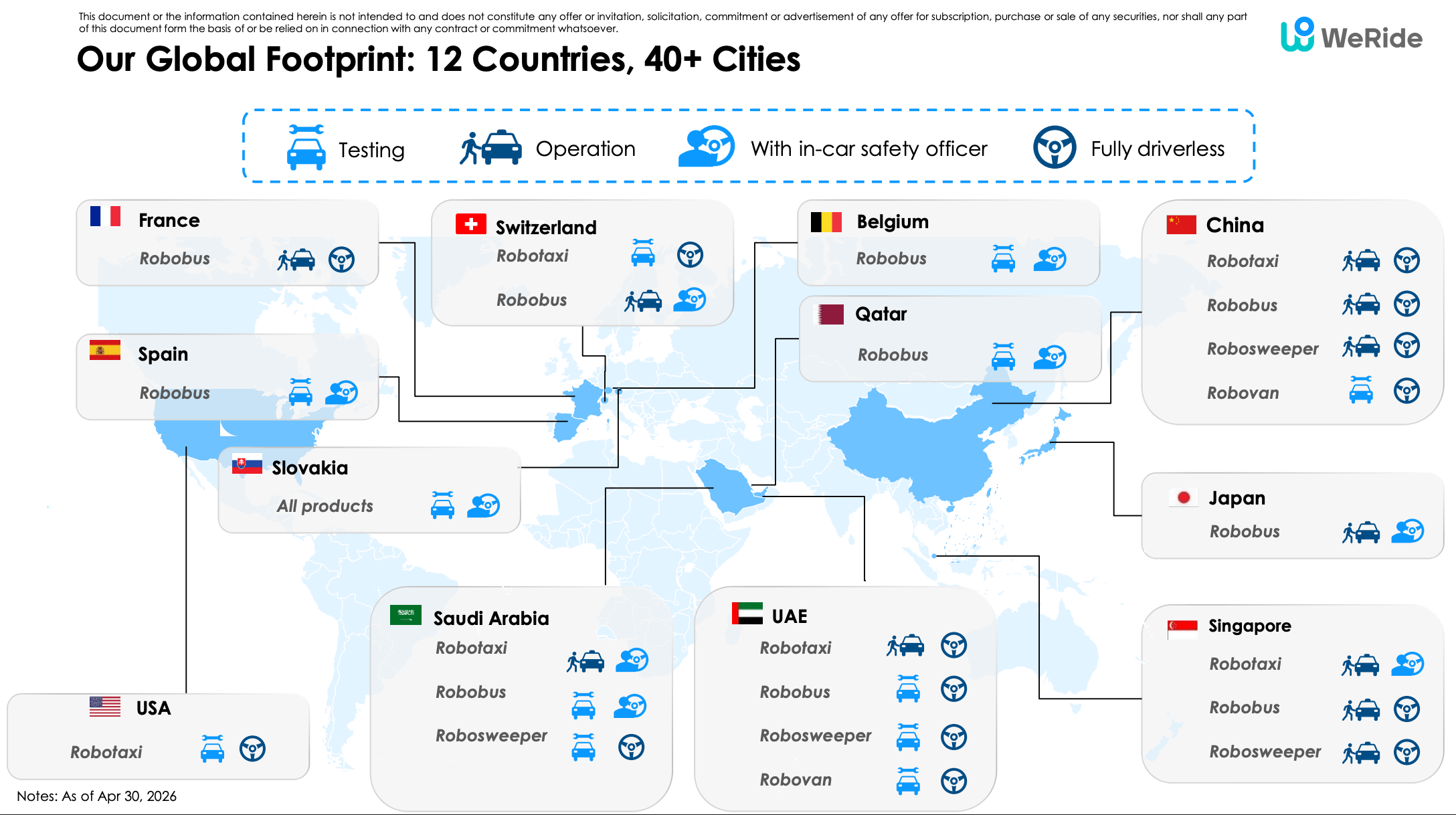
Before we move on to ADAS, it is worth zooming out on the global footprint. WeRide shared a deployment map in the earnings presentation covering every city it operates in, with the current status (testing, operational, with safety driver, fully driverless).
Source: WeRide Q1/2026 Investor Presentation
ADAS WRD 3.0 and the multi-chip story
WeRide’s WRD 3.0 ADAS stack has now been “adopted by nearly 30 vehicle models, including vehicles from leading OEMs, such as GAC and Chery,” per Han on the call. The GAC Aion N60, which entered presale in April, is the first mass-production vehicle running WeRide’s solution. Several of the in-production models are now shipping at “tens of thousands every month” levels.
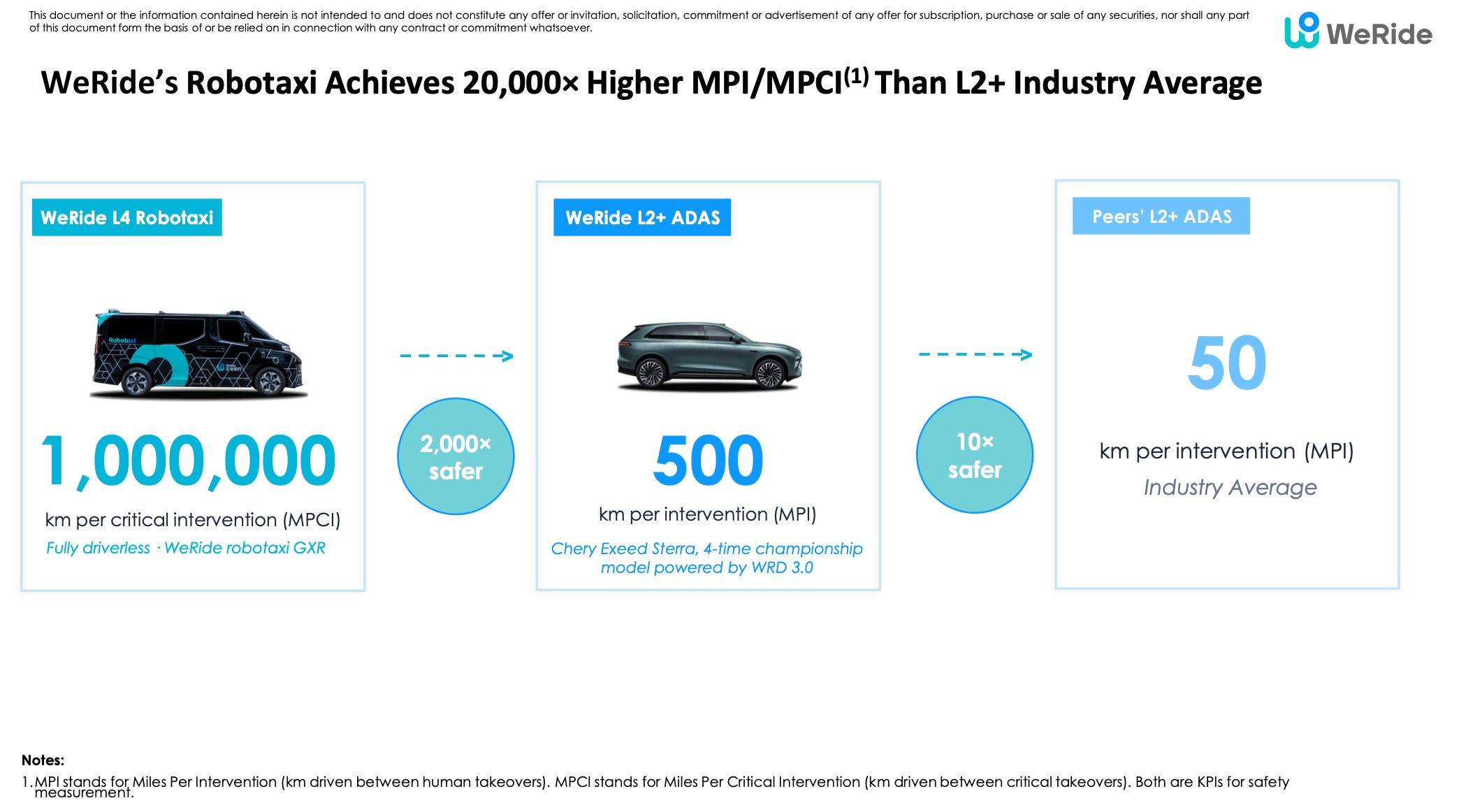
The performance argument WeRide is making is built around miles per critical intervention (MPCI). Han was direct on this point: “For L4-level autonomous driving, you can see numbers from WeRide and from Waymo. And the [miles] per critical intervention is at above 1 million kilometers level.” He compared that to ADAS competitors in China who are “aiming at to reach 1,000 kilometers of MPCI.” That is a three-order-of-magnitude gap.
Source: WeRide Q1/2026 Investor Presentation
On the multi-chip strategy, the WRD 3.0 stack now runs on three production chip platforms: NVIDIA DRIVE, Qualcomm Snapdragon, and SiEngine StarLight. Han’s reasoning for why this matters: “Different OEMs have different hardware preference. From OEMs, they want extremely cost-effective chips, [or] some OEMs want very high tops computational platform. And they have different supply chain requirements.” A multi-chip-capable ADAS stack lets WeRide land in OEM programmes without forcing them off their preferred silicon roadmap.
Why this works for WeRide: it expands the addressable OEM customer base without WeRide having to rebuild the system per customer. Han explicitly tied multi-chip flexibility to “faster mass production and great cost optimization, different chip platforms offer different costs and supply chain advantages.” Per the call, WeRide has secured ADAS supply deals across multiple OEMs that export Chinese vehicles globally, with shipments expected in Mid East Asia, Southeast Asia, and parts of Europe.
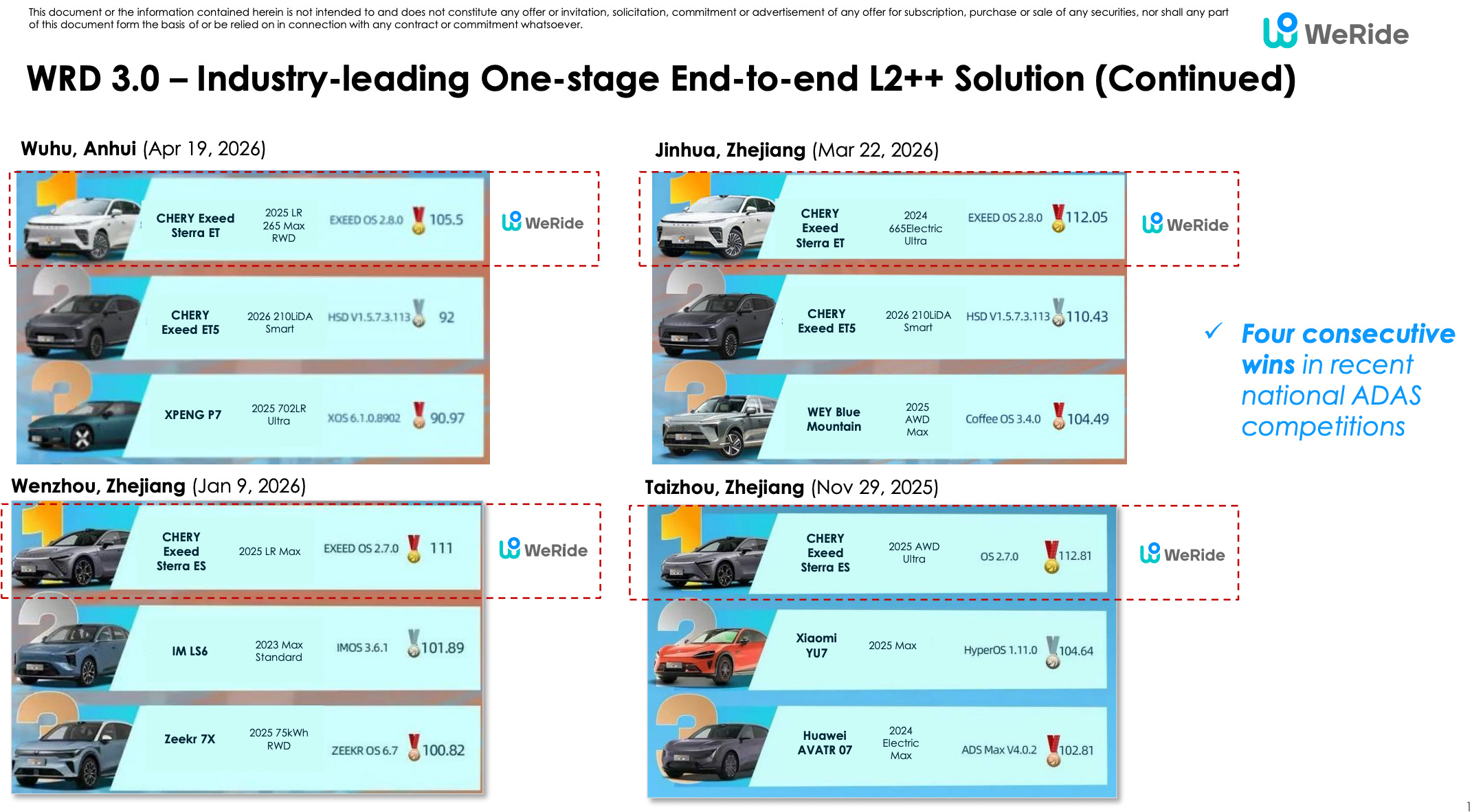
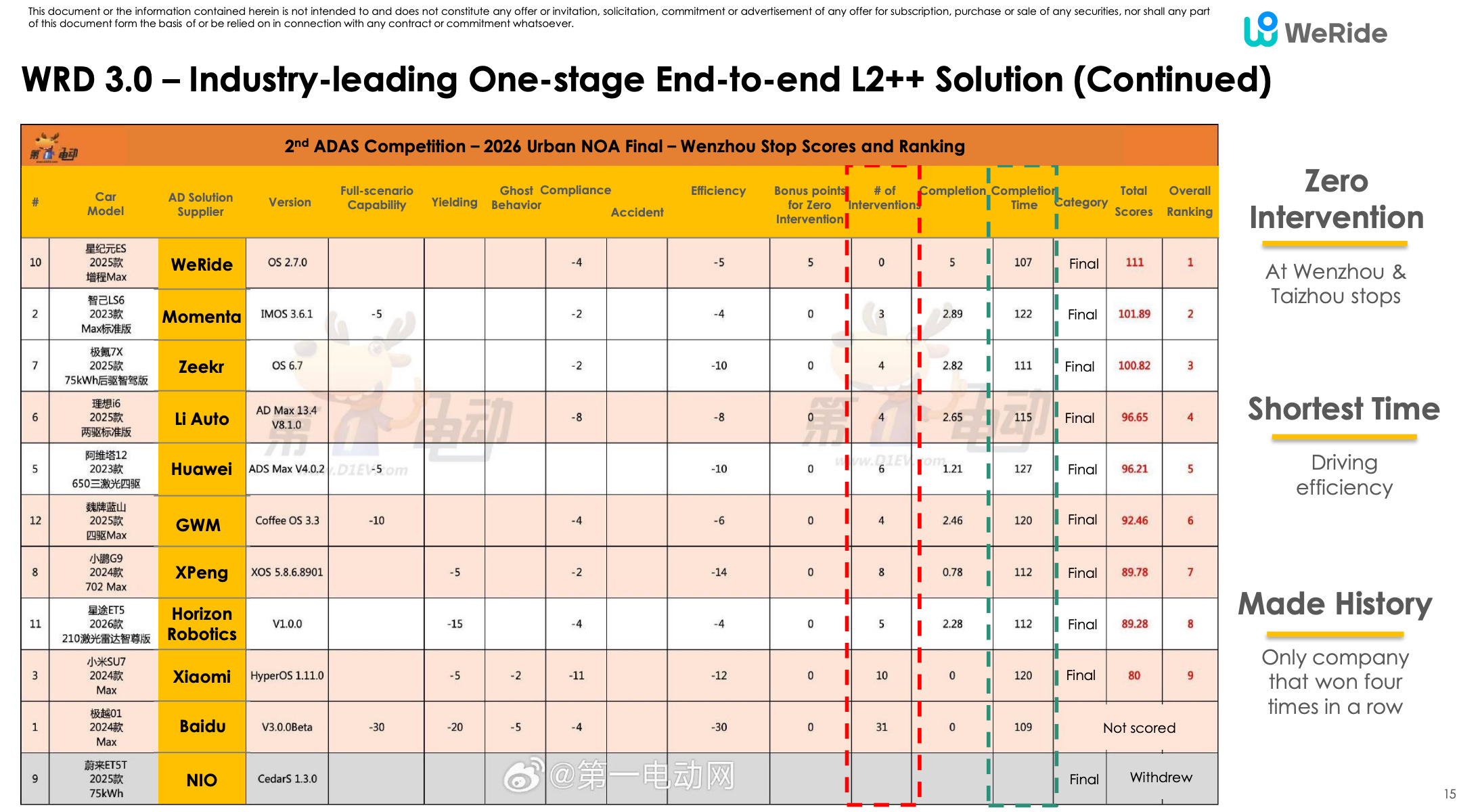
Han claimed WRD 3.0 has now won four consecutive Chinese urban intelligent driving competitions, beating Huawei's prior best run of two.
Source: WeRide Q1/2026 Investor Presentation
Uber holds >5% of WeRide
Confirmed on the call by Jennifer Li and the latest public filing: Uber holds over 5% of WeRide as a strategic shareholder. WeRide is Uber’s main international driverless robotaxi supplier in Dubai and Abu Dhabi, and additional cities are in the pipeline.
My take
WeRide keeps growing and keeps widening its global footprint. The fleet is now at 2,800 deployed vehicles (about 1,300 robotaxis), the service area in Guangzhou nearly doubled in four months, and the company is in 12 countries across more than 40 cities. The Q1 revenue is up 58% year-over-year.
The clearer signal this quarter, in my read, is that WeRide is increasingly tilting toward international as the primary growth engine, and it is using the unit-economics disclosure to make that case publicly. The illustrative UE model is not a forecast, but the shape of it (international markets 2x the margin and 12x the dollar profit of China) is exactly the message WeRide wants third-party fleet owners outside China to hear. The asset-light flywheel works only if partners want to put these vehicles on their balance sheets.
The Beijing L4 permit freeze from CW18 makes the international tilt more than a strategic preference. With the domestic permit pipeline frozen, China growth slows by construction. International is now where the marginal vehicle gets deployed, the marginal market gets opened, and the marginal partner gets onboarded. WeRide framed this on the call as a “short-term regulatory adjustment” rather than a structural shift, which is the correct posture for management to take. The operational reality is that the freeze is currently the single biggest reason to push harder overseas, and WeRide is responding accordingly.
Madrid is the city I am watching most closely. Han mentioned Madrid twice on the call as a city WeRide is preparing to deploy in, and he framed the corner-case work in Madrid as already done through the GENESIS simulation stack. Combine that with the existing European footprint (Slovakia entered in March as the fourth European market, Zurich on track for fully driverless commercial, TPG Geneva for robobus), and Madrid feels like the next European announcement. CFO Li teased “exciting news in more deployment in more cities in Europe hopefully soon.”
🔗 WeRide / WeRide (2) / earnings transcript / OBI
💡 Quick Takes
WAYVE SIGNS MOU WITH UK GOVERNMENT
The UK Department for Business and Trade signed a Memorandum of Understanding with Wayve covering safety assurance, large-scale simulation, and the integration of Wayve's self-driving stack into production-ready vehicle platforms. Wayve will share real-world trial data with regulators to inform future standards. Wayve has stated plans for commercial robotaxi trials in 2026 and consumer "supervised autonomy software" in 2027.
🔗 GOV.UK
VOLVO AUTONOMOUS + DSV LAUNCH AUTONOMOUS FREIGHT IN TEXAS
Volvo Autonomous Solutions and DSV announced the first commercial truckload using the Volvo VNL Autonomous integrated with the Aurora Driver. Operations run between Aurora's Dallas and Houston terminals, with a safety driver onboard during initial phase.
🔗 DSV
TIER IV LAUNCHES AUTOMOTIVE-GRADE MP CAMERA SERIES FOR L4
Japanese AV company Tier IV released its MP camera series on May 13, with three initial automotive-grade models aimed at L4 deployment. The cameras are Autoware-compatible (Tier IV is the lead Autoware contributor) and built for commercial-scale manufacturing through partners ADLINK, Connect Tech, Neousys, and EUREKA.
🔗 PR Newswire
XIAOMI OPEN-SOURCES ONEVL AUTONOMOUS DRIVING FRAMEWORK
Xiaomi released and open-sourced OneVL. The framework combines vision-language-action models, world models, and latent-space reasoning in a single-step architecture, and reportedly outperforms latent-space chain-of-thought baselines while matching the inference speed of lightweight answer-only models. Lei Jun confirmed the model and codebase are both open.
🔗 Gasgoo
DEPARTMENT OF WAR PICKS APPLIED INTUITION FOR AUTONOMY FACTORY
The Chief Digital and AI Office (CDAO) selected Applied Intuition to build the platform underpinning Autonomy Factory, the new program to accelerate testing and fielding of autonomous systems across the Department of War. The contract sits on Applied Intuition's Axion toolchain and data engine. The framing is self-serve digital infrastructure for autonomy across mission types. Dual-use revenue is now a real business, not a side bet.
🔗 PR Newswire
U.S. SUGAR DEPLOYS AUTONOMOUS TRACTOR FLEET IN THE US
U.S. Sugar, Everglades Equipment Group, and Autonomous Solutions Inc. are deploying the nation's largest commercial fleet of autonomous tractors: four John Deere 8R Series and one 9R Series, running 24/7 across 255,000 acres of South Florida sugarcane. ASI's Vehicle Automation Kit lets one operator manage multiple vehicles from a central command station.
🔗 Business Wire
KODIAK ENTERS CANADA AND TIMBER HAULING WITH WEST FRASER
Kodiak AI confirmed a pilot with West Fraser Timber to haul logs in Alberta later this year. This is Kodiak's first international operation and first timber-industry deployment. FPInnovations facilitated the partnership. West Fraser cited safety, the driver shortage, and consistency of mill supply as the drivers.
🔗 Kodiak
ANDURIL UK DOWN-SELECTED FOR BRITISH ARMY PROJECT NYX
The UK MoD down-selected Anduril UK for the next phase of Project NYX, the British Army programme to develop autonomous wingman drones for the AH-64E Apache. The £10M MoD investment splits across Anduril UK, BAE Systems Operations, Tekever, and Thales UK. The MoD plans to select up to two contenders in autumn 2026 for prototype work, with an operational variant targeted for 2030. Anduril UK is teaming with GKN Aerospace (airframes) and Archer Aviation (VTOL design and hybrid powertrain).
🔗 Anduril
🎧 Autonomy Insiders
In Episode 10 of Autonomy Insiders, I sat down with Chris Moore, President of Apollo ibott 1971, to unpack why insurance is the unsung gatekeeper of AV deployment and why most insurers are still sitting on the sidelines while autonomy scales.
Chris explains why autonomous vehicles don’t fit any traditional insurance silo. He walks through how Apollo prices a risk with no decade-long loss history, why frequency is easy to model but severity is the real problem, and how US plaintiff lawyers and nuclear verdicts shape AV underwriting more than the technology itself.
The conversation also covers the new Uber AV Insurance Program (AVIP), launched with Apollo as risk taker and Marsh as broker, and how it covers Uber’s entire AV partner ecosystem.
📚 Worth Reading/Listening
Timothy B. Lee: Why it might not make sense for you to own a self-driving car
🔗 Understanding AI
Phil Koopman: How Safe Is Really “Safe Enough” for Autonomous Vehicles?
🔗 Phil & Junko on AV Safety
📊 Weekly Performance
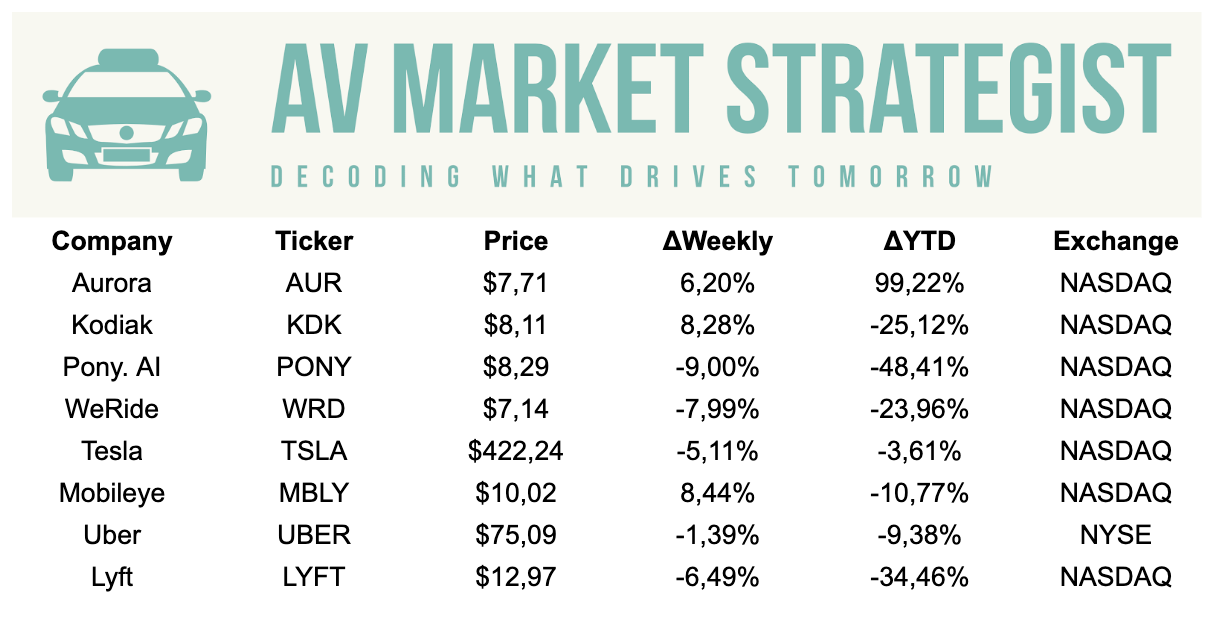
Note: Stock performance data as of May 17th, 2026. Past performance does not indicate future returns.
Thanks for reading!
If you found value in this newsletter, please consider sharing it with a friend or colleague who might benefit from these insights.
And if you haven’t already, subscribe to stay updated on the latest developments in the autonomous driving industry.
Disclaimer: This newsletter is provided for general informational and educational purposes only and is subject to change without notice. While we obtain information from sources we believe to be reliable, we do not guarantee its accuracy, completeness, or timeliness. We accept no responsibility for any actions taken based on this newsletter or for any losses resulting from its use. Nothing in this newsletter constitutes, or is intended to constitute, financial, investment, trading, legal, accounting, or tax advice. The content does not take into account your individual objectives, financial situation, or needs and must not be relied upon as personalized recommendations to buy, sell, or hold any security or other financial instrument. You should always do your own research and consult a licensed financial professional before making any investment decisions. Any opinions or views expressed in this newsletter are those of the authors at the time of publication and may change without notice. They do not necessarily reflect the opinions of any affiliated entities.
Great overview thanks!
Hands 👋 free charging anyone!